Transistors are the core building blocks of modern electronics. From smartphones and computers to industrial automation systems, electric vehicles, communication networks, and renewable energy infrastructure, nearly every electronic device depends on transistors for switching, amplification, and intelligent signal control.
In 2026, semiconductor technologies continue to evolve rapidly, enabling smaller, faster, and more energy-efficient electronic systems. Billions of transistors are manufactured every day to support AI computing, automotive electronics, industrial robotics, advanced communication systems, and high-performance consumer devices.
This comprehensive guide by Simplytronix explains what transistors are, how they work, their major types, applications, advantages, and the future of transistor technology in modern electronics.
What is a Transistor?
A transistor is a semiconductor device used to control or amplify electrical signals and power within an electronic circuit.
Transistors act as electronically controlled switches or amplifiers and are fundamental to both analog and digital electronics.
Modern electronic systems use transistors for:
- Electronic switching
- Signal amplification
- Voltage regulation
- Power management
- Motor control
- Digital processing
- Communication systems
Why Transistors Revolutionized Electronics
Before transistors were invented, electronic systems relied on vacuum tubes. These devices were large, inefficient, fragile, and consumed significant power.
The invention of the transistor transformed the electronics industry by enabling compact, reliable, and highly efficient electronic devices.
| Technology | Characteristics | Limitations |
|---|---|---|
| Vacuum Tubes | Early electronic switching and amplification | Large size, high heat, high power consumption |
| Transistors | Compact, fast, reliable, energy efficient | Continuous scaling challenges in advanced nodes |
Basic Structure of a Transistor
Most transistors contain three terminals used to control current flow.
| Terminal Type | Function |
|---|---|
| Control Terminal | Receives input control signal |
| Input Terminal | Accepts incoming current or voltage |
| Output Terminal | Controls output current flow |
The exact naming of these terminals depends on the transistor type.
How Does a Transistor Work?
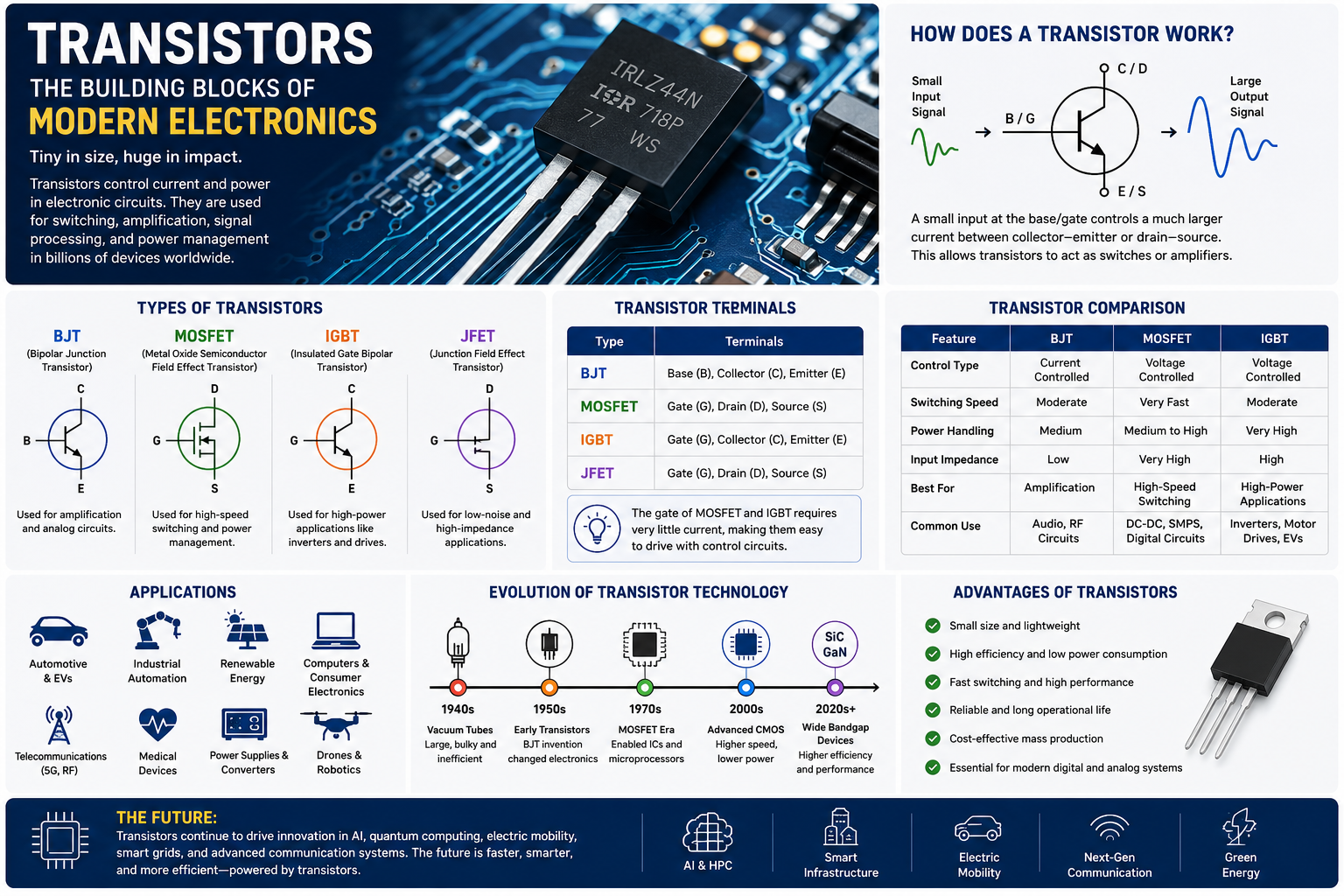
A transistor operates by using a small electrical signal to control a much larger electrical current.
In switching applications, transistors rapidly turn circuits ON and OFF. This switching action forms the basis of digital electronics and computer processing.
In amplification applications, a weak electrical signal is amplified into a stronger output signal.
| Operating Mode | Purpose |
|---|---|
| Switching | Controls power delivery and digital logic operations |
| Amplification | Strengthens weak electrical signals |
Main Types of Transistors
Several transistor technologies are used in modern electronics, each optimized for different applications.
| Transistor Type | Full Form | Main Applications |
|---|---|---|
| BJT | Bipolar Junction Transistor | Analog circuits and amplification |
| MOSFET | Metal Oxide Semiconductor Field Effect Transistor | Digital electronics and power switching |
| IGBT | Insulated Gate Bipolar Transistor | Industrial power systems and EVs |
| JFET | Junction Field Effect Transistor | Low-noise signal amplification |
Bipolar Junction Transistor (BJT)
BJTs were among the earliest transistor technologies adopted for commercial electronics.
A BJT contains three terminals:
| Terminal | Function |
|---|---|
| Base | Controls transistor operation |
| Collector | Receives current |
| Emitter | Outputs current |
BJTs are commonly used in:
- Audio amplifiers
- Analog signal processing
- RF circuits
- Communication equipment
- Sensor electronics
MOSFET (Metal Oxide Semiconductor Field Effect Transistor)
MOSFETs are among the most widely used semiconductor devices in modern electronics because of their fast switching speed, low power consumption, and compact size.
| Feature | Benefit |
|---|---|
| Fast Switching | Supports high-speed digital systems |
| Low Power Consumption | Improves energy efficiency |
| Compact Structure | Ideal for miniaturized devices |
| Low Heat Generation | Improves reliability and thermal performance |
MOSFETs are heavily used in:
- Microprocessors
- Smartphones
- Computers
- Power supplies
- Battery systems
- Embedded electronics
IGBT (Insulated Gate Bipolar Transistor)
IGBTs combine the gate-control advantages of MOSFETs with the high-current capability of bipolar transistors.
These devices are optimized for medium- and high-power applications.
| Industry | Typical IGBT Applications |
|---|---|
| Electric Vehicles | Traction inverters and motor drives |
| Industrial Automation | Variable frequency drives and robotics |
| Renewable Energy | Solar and wind inverters |
| Transportation | Railway traction systems |
Comparison of Major Transistor Technologies
| Parameter | BJT | MOSFET | IGBT |
|---|---|---|---|
| Control Type | Current Controlled | Voltage Controlled | Voltage Controlled |
| Switching Speed | Moderate | Very Fast | Moderate |
| Power Handling | Medium | Medium to High | Very High |
| Main Strength | Amplification | High-speed switching | High-power efficiency |
| Main Applications | Analog electronics | Digital electronics | Industrial systems |
Applications of Transistors in Modern Electronics
Transistors are essential across nearly every electronics industry.
| Industry | Applications |
|---|---|
| Consumer Electronics | Smartphones, laptops, gaming systems, televisions |
| Automotive | Electric vehicles, ADAS, infotainment systems |
| Industrial Automation | Robotics, PLC systems, motor controllers |
| Telecommunications | 5G infrastructure and RF communication systems |
| Medical Equipment | Monitoring systems and imaging devices |
| Renewable Energy | Solar inverters and energy storage systems |
Advantages of Transistors
| Advantage | Benefit |
|---|---|
| Compact Size | Enables miniaturized electronics |
| High Efficiency | Reduces power consumption |
| Fast Switching | Supports high-speed processing |
| Long Operational Life | Improves system reliability |
| Low Heat Generation | Enhances thermal performance |
| Mass Production Capability | Supports large-scale semiconductor manufacturing |
Growth of Semiconductor Technology
Modern semiconductor manufacturing continuously improves transistor performance while reducing size and power consumption.
| Technology Trend | Impact |
|---|---|
| Advanced Process Nodes | Higher transistor density and faster processing |
| AI Processors | Massive computing performance improvements |
| 3D Packaging | Compact high-performance electronic systems |
| Wide-Bandgap Semiconductors | Improved efficiency and thermal capability |
Challenges in Modern Transistor Development
| Challenge | Description |
|---|---|
| Heat Management | High-performance chips generate significant thermal loads |
| Manufacturing Complexity | Advanced fabrication requires highly sophisticated processes |
| Power Density | Smaller chips create thermal and reliability challenges |
| Material Limitations | Traditional silicon approaches physical scaling limits |
Future of Transistor Technology
Future transistor innovations are expected to drive major advancements in:
- Artificial Intelligence
- Quantum computing
- Electric vehicles
- Industrial automation
- Advanced robotics
- High-speed networking
- Smart infrastructure
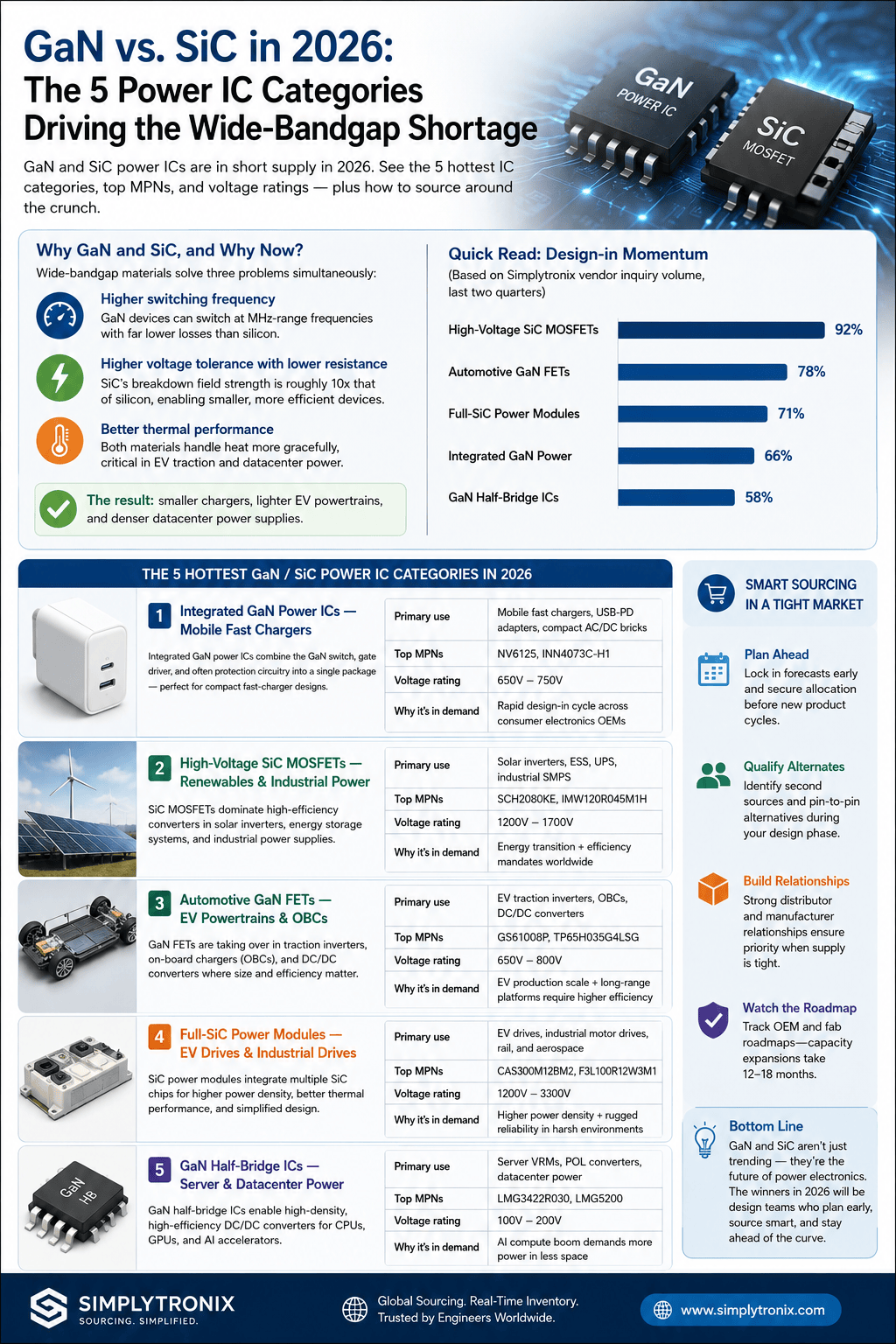
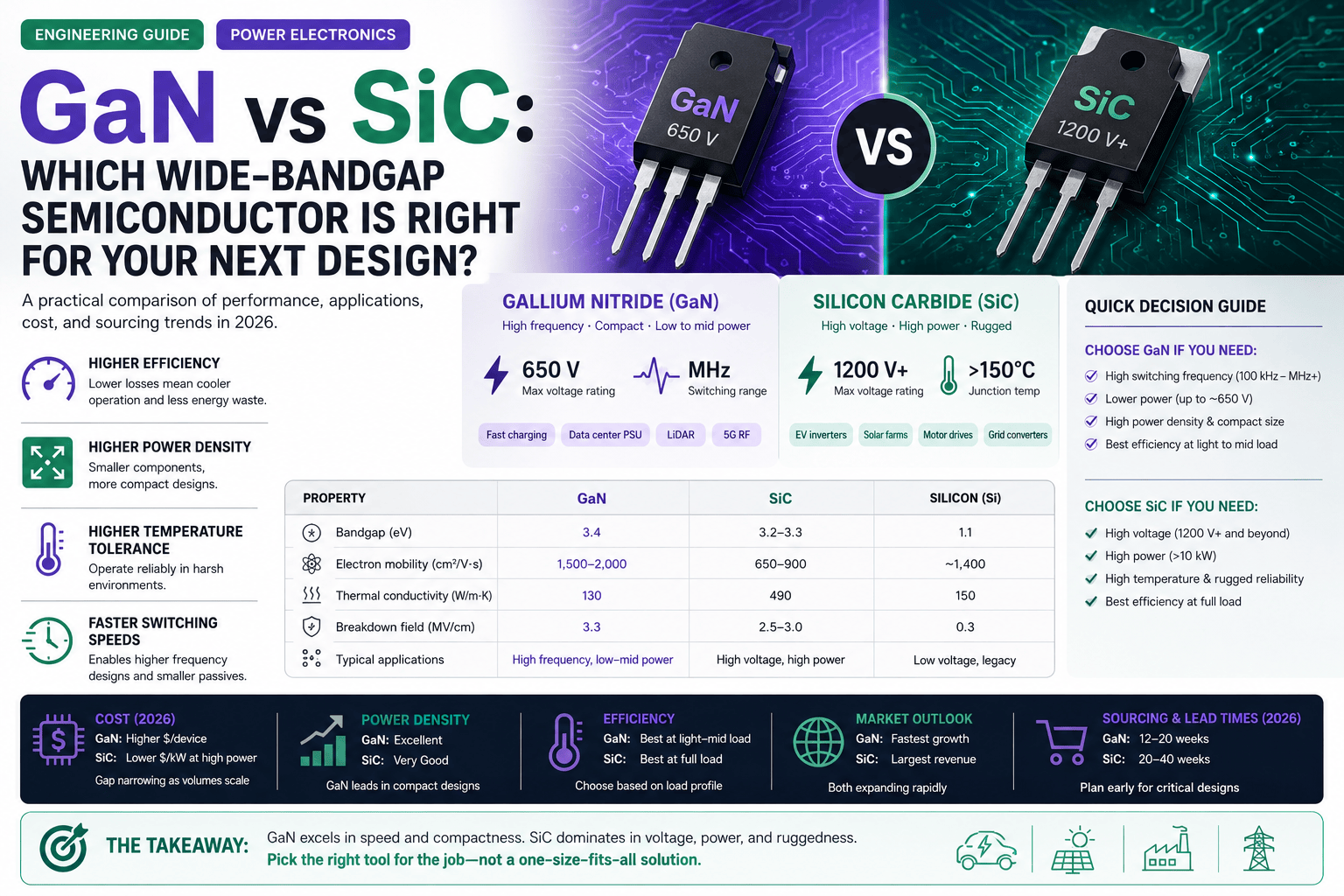
Emerging semiconductor materials such as Silicon Carbide (SiC) and Gallium Nitride (GaN) are enabling faster switching, higher efficiency, and improved thermal performance in next-generation electronic systems.
Evolution of Transistor Technology
| Technology Era | Key Innovation | Industry Impact |
|---|---|---|
| 1940s | Early BJTs | Replacement of vacuum tubes |
| 1970s | MOSFET Expansion | Development of microprocessors |
| 1990s | Advanced CMOS | Rapid computing performance growth |
| 2010s | FinFET Technology | Higher efficiency semiconductor devices |
| 2026+ | SiC and GaN Devices | Advanced power electronics and EV systems |
Conclusion
Transistors have transformed the world of electronics by enabling faster computing, efficient power management, compact device design, and intelligent automation systems. From consumer electronics and industrial equipment to electric vehicles and advanced communication networks, transistors remain at the center of technological innovation.
As semiconductor manufacturing continues to evolve, modern transistor technologies are becoming smaller, faster, more energy efficient, and capable of handling increasingly complex applications. Technologies such as advanced MOSFETs, IGBTs, Silicon Carbide (SiC), and Gallium Nitride (GaN) devices are shaping the future of power electronics, AI infrastructure, automotive engineering, and renewable energy systems.
Understanding transistor fundamentals is essential for engineers, students, designers, and electronics enthusiasts working with modern electronic systems. Whether developing embedded devices, industrial automation platforms, or next-generation energy solutions, transistors remain one of the most critical components in electronic circuit design.
Simplytronix provides access to a wide range of semiconductor components, industrial electronic parts, and advanced electronic solutions to support modern engineering and manufacturing requirements.