If you've tried to place an order for a high-voltage SiC MOSFET or an integrated GaN power stage in the last two quarters, you already know the story: allocation, extended lead times, and design engineers scrambling for second sources. Wide-bandgap (WBG) semiconductors — Gallium Nitride (GaN) and Silicon Carbide (SiC) — have moved from "emerging technology" to "default choice" faster than almost any other component category in power electronics history.
At Simplytronix, we track sourcing patterns across our vendor network daily, and one trend is unmistakable: five specific IC classes account for the overwhelming majority of GaN/SiC demand right now. This guide breaks each one down — what it does, why it's hot, and which manufacturer part numbers (MPNs) design teams are actually specifying on their BOMs.
Why GaN and SiC, and Why Now?
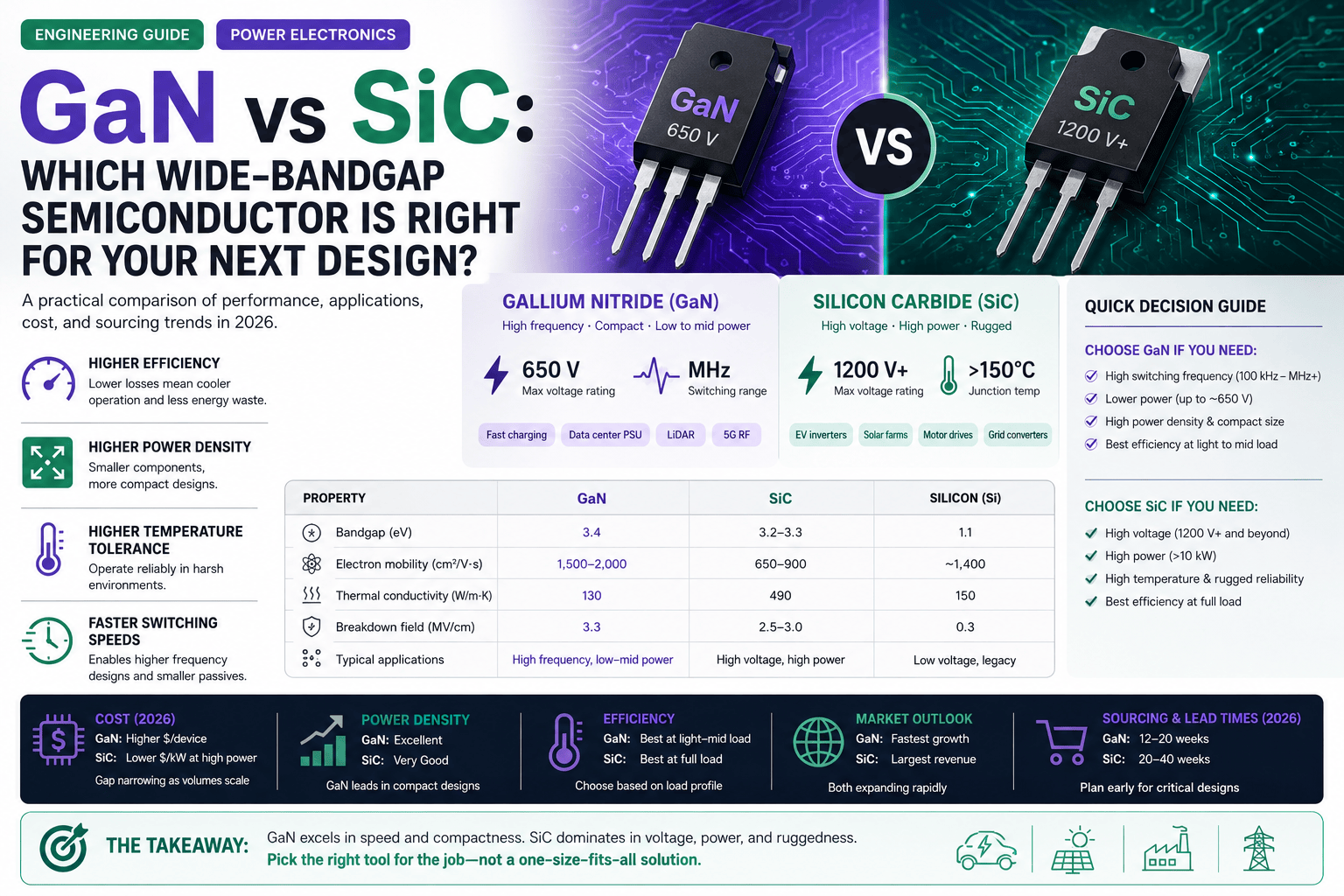
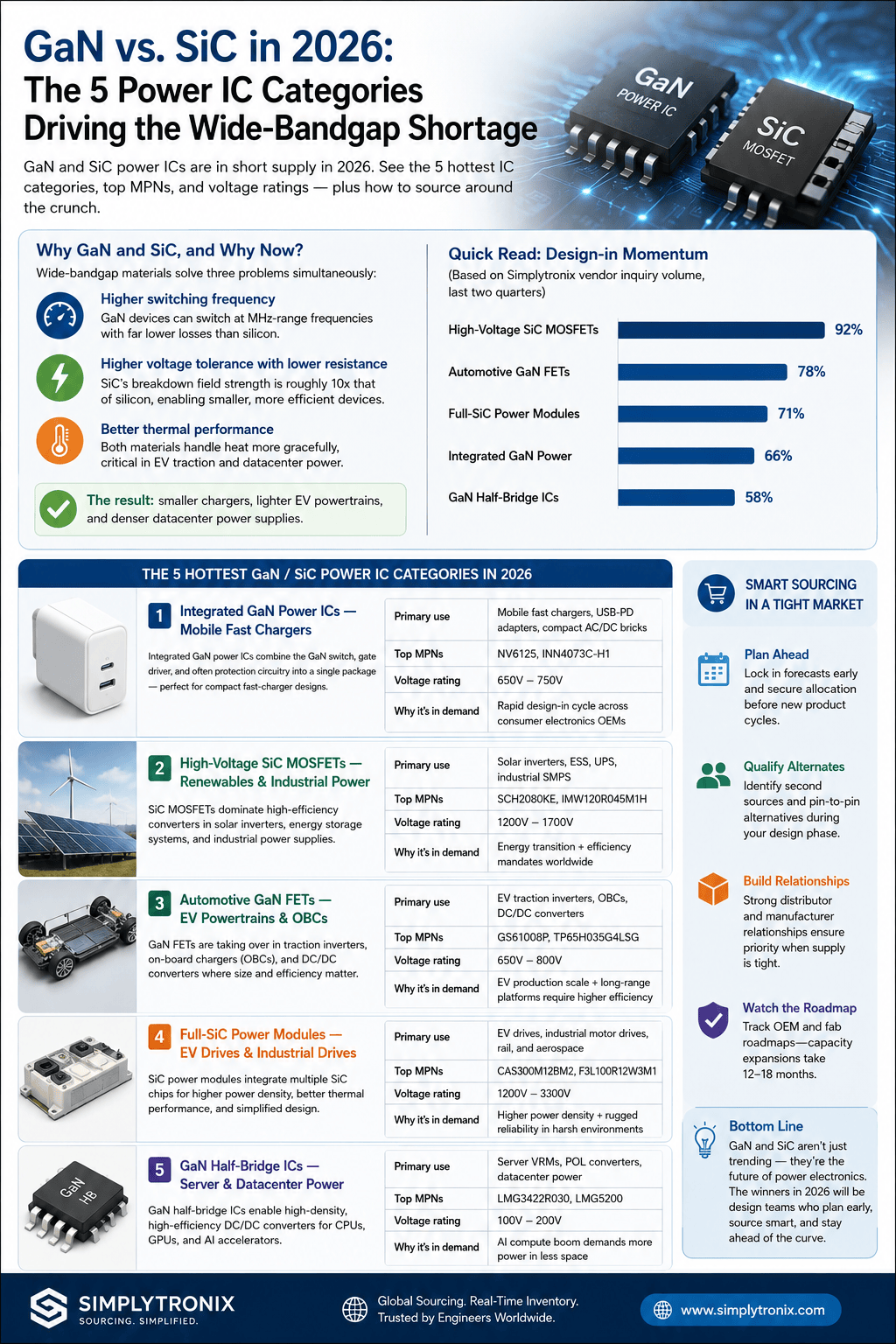
Silicon has been the workhorse of power electronics for seven decades, but it's running into hard physical limits. Wide-bandgap materials solve three problems simultaneously:
- Higher switching frequency — GaN devices can switch at MHz-range frequencies with far lower losses than silicon, shrinking magnetics and capacitors.
- Higher voltage tolerance with lower resistance — SiC's breakdown field strength is roughly 10x that of silicon, enabling smaller, more efficient high-voltage devices.
- Better thermal performance — Both materials handle heat more gracefully, which matters enormously in EV traction and datacenter power delivery, where every watt of loss becomes a cooling problem.
The result: smaller chargers, lighter EV powertrains, and denser datacenter power supplies. That's the pull driving the five categories below.
1. Integrated GaN Power ICs — Mobile Fast Chargers
This is the category most consumers unknowingly touch every day. Integrated GaN power ICs combine the GaN switch, gate driver, and often protection circuitry into a single monolithic package, which is exactly what compact fast-charger designs need. A 65W charger that used to be the size of a deck of cards is now smaller than a matchbox, largely because of this device class.
| Attribute | Detail |
|---|---|
| Primary use | Mobile fast chargers, USB-PD adapters, compact AC/DC bricks |
| Top MPNs | NV6125, INN4073C-H1 |
| Voltage rating | 650V – 750V |
| Why it's in demand | Rapid design-in cycle across consumer electronics OEMs chasing smaller, cooler-running chargers |
What buyers should know: these parts move fast through consumer electronics product cycles, so allocation windows tend to open and close quickly around new phone and laptop launches. If your BOM depends on one of these MPNs, locking in quantity ahead of a product refresh cycle is worth the carrying cost.
2. High-Voltage SiC MOSFETs — Solar & EV Chargers
This is currently the single hottest category we track. High-voltage SiC MOSFETs sit at the heart of solar string inverters, EV DC fast chargers, and increasingly, grid-tied energy storage systems. The appeal is straightforward: lower on-resistance at high voltage means smaller heatsinks, higher power density, and better system-level efficiency — all of which translate directly into lower cost per installed watt for solar and charging infrastructure.
| Attribute | Detail |
|---|---|
| Primary use | Solar string inverters, EV DC fast chargers, energy storage |
| Top MPNs | IMW120R030M1H, XKSA1 / C3M0015065K |
| Voltage rating | 650V – 1200V |
| Why it's in demand | Global buildout of solar generation and DC fast-charging networks, both scaling faster than fab capacity |
Lead times on this category have been the most volatile of the five. Infrastructure projects (utility-scale solar, charging corridors) tend to buy in large, lumpy batches, which can drain distributor stock quickly. We recommend qualifying at least one alternate MPN with matching Rds(on) and voltage rating before committing a design to a single source.
3. Automotive GaN FETs — On-Board EV Chargers
On-board chargers (OBCs) — the electronics that convert AC grid power into DC to charge an EV's battery — are one of the clearest wins for GaN in automotive. Automotive-grade GaN FETs let OBC designs hit higher switching frequencies, shrinking the magnetics and improving power density without sacrificing the reliability automotive qualification (AEC-Q101) demands.
| Attribute | Detail |
|---|---|
| Primary use | On-board EV chargers (OBC) |
| Top MPNs | IGO60R070D1A, UMA1 / LMG3422R050RQZT |
| Voltage rating | 600V |
| Why it's in demand | EV production ramps across multiple OEMs, each qualifying GaN-based OBC platforms in parallel |
Automotive qualification cycles are long, which is actually good news for buyers: once an MPN is designed into a production vehicle platform, demand becomes highly predictable for years. The risk is on the front end — during qualification, engineering teams often need small quantities of multiple candidate parts quickly, and distributor partners who can turn around automotive-grade samples fast become a genuine competitive advantage.
4. Full-SiC Power Modules — EV Traction Inverters
If high-voltage SiC MOSFETs are the workhorse discrete device, full-SiC power modules are the flagship. These are multi-die modules — typically half-bridge or full-bridge configurations — built entirely from SiC dies rather than mixing SiC with silicon. They sit directly in the traction inverter, converting battery DC to the AC that drives an EV's motor, and they're rated for the highest voltages and currents of any category on this list.
| Attribute | Detail |
|---|---|
| Primary use | EV traction inverters |
| Top MPNs | A2F12M12W2-F1, NXH010P120MNF1P |
| Voltage rating | 1200V |
| Why it's in demand | Every major EV platform launch adds another design win; module-level packaging means fewer, higher-value orders |
Because these are high-value, application-specific modules, they carry the longest lead times on this list — often quoted in dozens of weeks during allocation periods. Traction inverter programs typically lock in supply agreements 12-18 months ahead of production, so if you're sourcing for a lower-volume program (motorsport, industrial EV, off-highway), building the relationship with your distributor early matters more here than anywhere else on this list.
5. GaN Half-Bridge ICs — Telecom & Datacenters
The fifth category is quieter in the press but arguably just as consequential: GaN half-bridge ICs powering telecom infrastructure and datacenter power supplies. AI compute buildouts have pushed datacenter power density requirements to levels silicon simply can't hit efficiently, and GaN half-bridge stages are becoming the default building block for 48V bus converters and high-efficiency PSUs.
| Attribute | Detail |
|---|---|
| Primary use | Telecom power supplies, datacenter 48V bus converters |
| Top MPNs | LMG5200MOFT, GAN063-650WSA |
| Voltage rating | 80V – 650V |
| Why it's in demand | AI/HPC datacenter buildouts driving unprecedented power delivery density requirements |
This category has the widest voltage span on the list — from 80V low-voltage bus converter applications up to 650V front-end PFC stages — which reflects how broadly GaN half-bridge topology has been adopted across the power chain, not just at one conversion stage.
The Full Picture: Side-by-Side Comparison
| IC Category | Key Application | Top MPNs | Voltage Rating |
|---|---|---|---|
| Integrated GaN Power | Mobile Fast Chargers | NV6125 / INN4073C-H1 | 650V – 750V |
| High-Voltage SiC MOSFETs | Solar & EV Chargers | IMW120R030M1H, XKSA1 / C3M0015065K | 650V – 1200V |
| Automotive GaN FETs | On-Board EV Chargers | IGO60R070D1A, UMA1 / LMG3422R050RQZT | 600V |
| Full-SiC Power Modules | EV Traction Inverters | A2F12M12W2-F1, NXH010P120MNF1P | 1200V |
| GaN Half-Bridge ICs | Telecom & Datacenters | LMG5200MOFT, GAN063-650WSA | 80V – 650V |
Sourcing Strategy: What Buyers Should Actually Do
Knowing which categories are hot is only half the battle. Here's how procurement and design teams are navigating the current WBG market:
- Dual-source early. For every critical MPN, qualify a second-source part with matching electrical characteristics before you're forced to under supply pressure. This is especially true for the SiC MOSFET and full-SiC module categories, where lead times are longest.
- Separate consumer-cycle parts from infrastructure-cycle parts. Integrated GaN power ICs for chargers move on consumer product cadences (fast, high-volume, price-sensitive). Traction inverter modules move on 12-18 month automotive program cadences. Your inventory strategy should match the category.
- Verify authenticity on high-demand parts. Allocation pressure is exactly when counterfeit and remarked parts enter the supply chain. Cross-check date codes, package markings, and datasheet parameters against the manufacturer's official documentation before accepting stock from unfamiliar sources.
- Watch voltage headroom, not just rating. Several of these categories span a wide voltage range (80V-650V for GaN half-bridge ICs, for example). Don't over-spec voltage rating just for margin — it often means unnecessary Rds(on) penalty and cost.
- Build the vendor relationship before you need it. The teams getting parts fastest during allocation periods are the ones who had standing quotes and volume forecasts in place before the crunch hit — not the ones scrambling with a spot order.
Where Simplytronix Fits In
We track availability, lead times, and authenticity risk across all five of these categories daily through our vendor network. Whether you're sourcing a handful of samples for a design qualification or locking in a production allocation for an EV traction inverter program, our team can help you find the right MPN — or a verified alternate — before a shortage becomes your bottleneck.
Reach out to our sourcing team to get a live quote on any of the parts listed above, or to discuss a longer-term supply strategy for your GaN/SiC-based design.