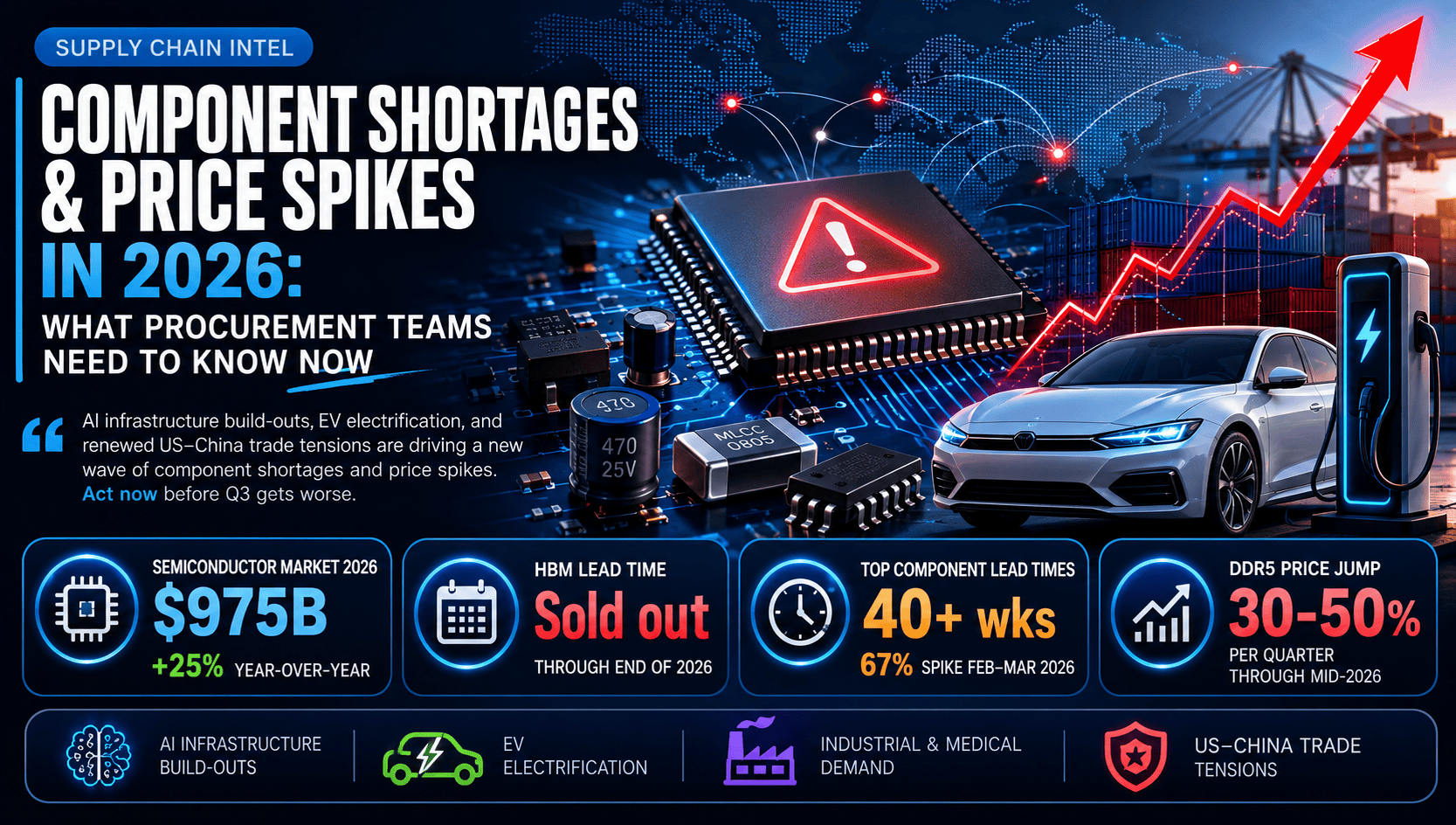
AI infrastructure build-outs, EV electrification, and renewed US–China trade tensions are driving a new wave of component shortages and price spikes. Here's what procurement teams need to know right now — and how to act before Q3 gets worse.
The six categories under the most pressure
Not all shortages are equal. The 2026 crunch is selective — concentrated in specific part families rather than the broad sweeping stockouts of 2021–2022. Below is a category-by-category breakdown of where buyers are feeling the most pain.
| Component | Key drivers | Lead time | Price trend | Risk level |
|---|---|---|---|---|
| HBM / DRAM | AI data center build-out | Sold out, allocation only | +30–50% / quarter | Critical |
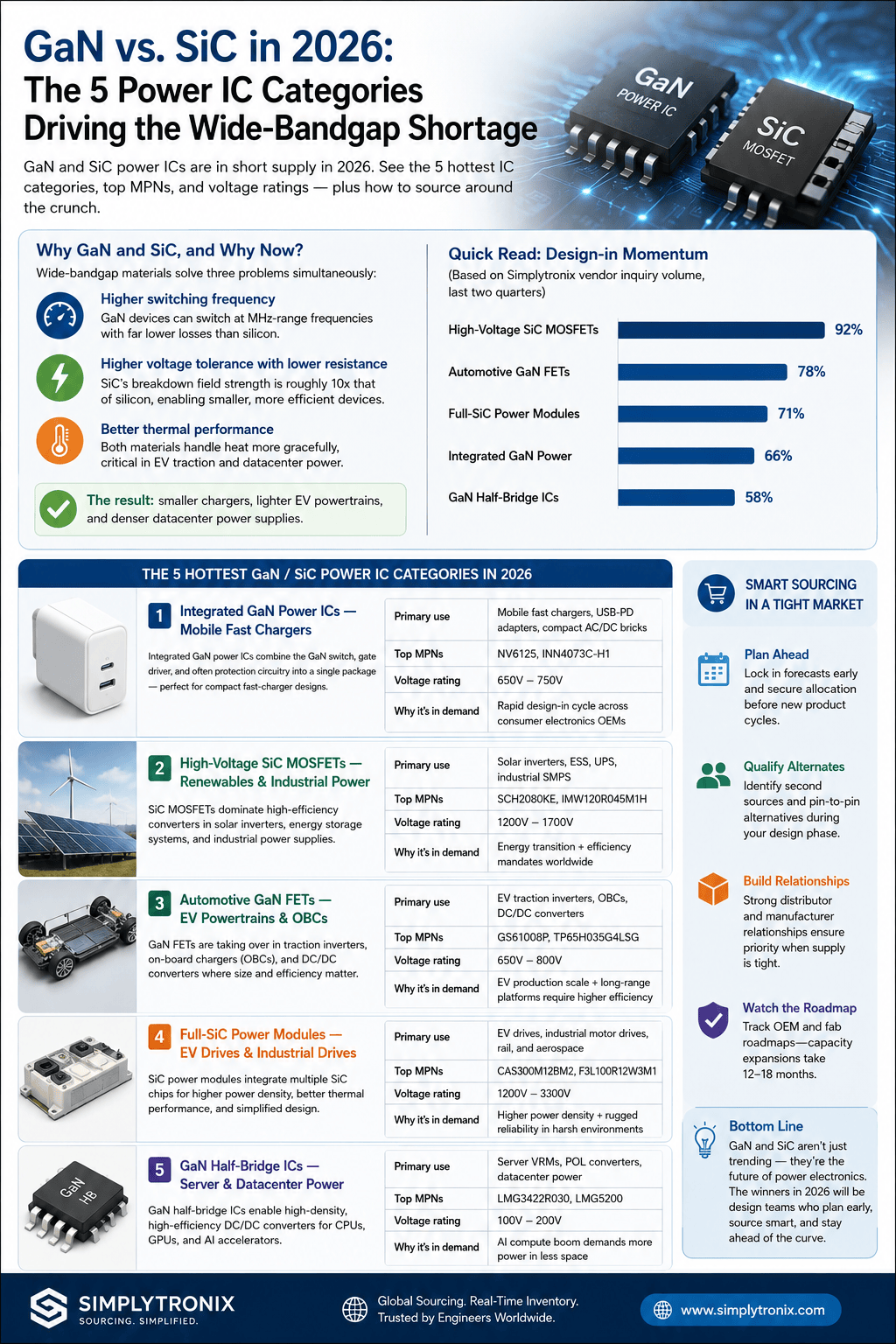
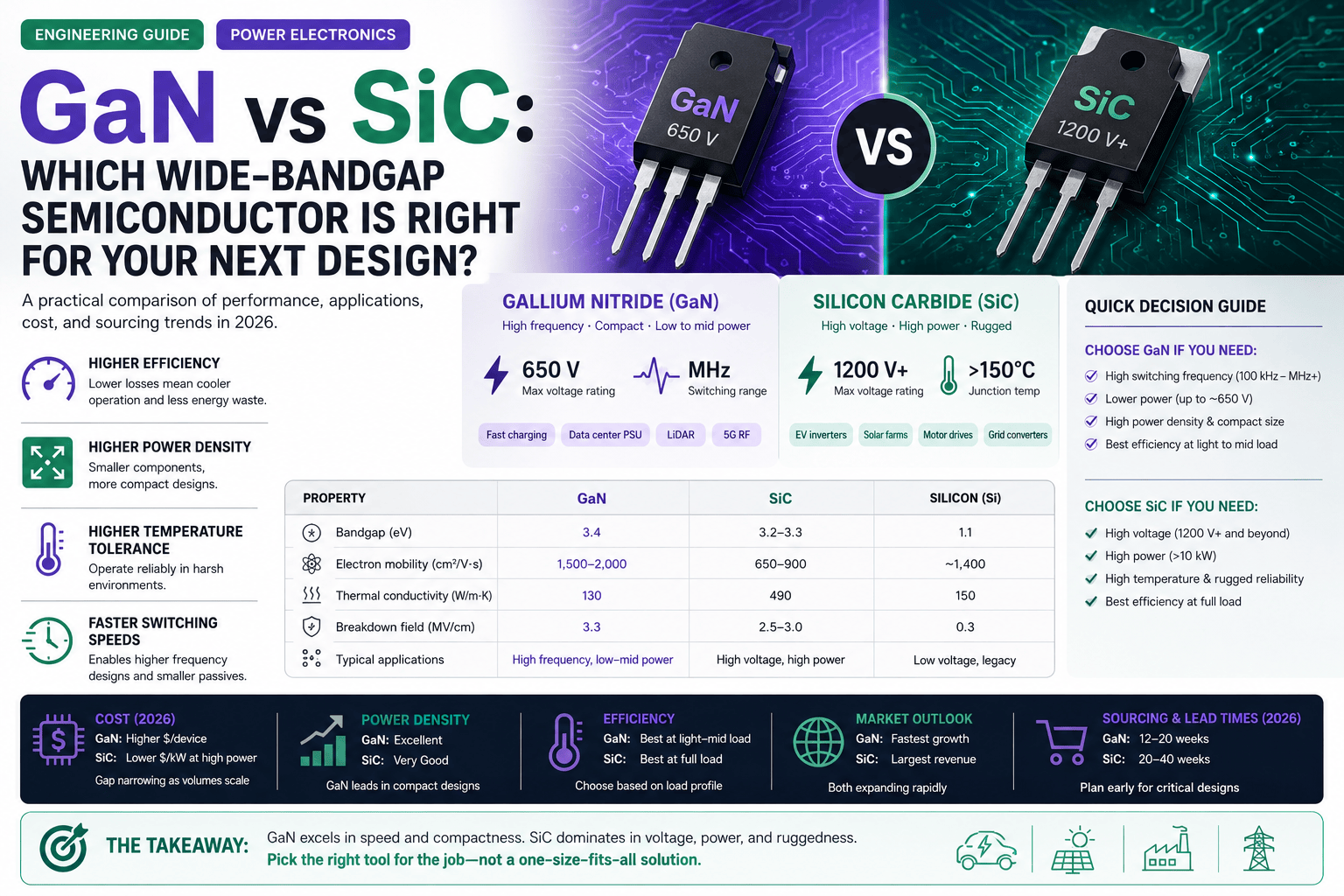
| SiC MOSFETs | EV powertrains, onboard chargers | 52+ weeks | Spot 2–5× book | Critical |
| Automotive MCUs | ADAS, EV control units | 40–52 weeks | +10–15% | Critical |
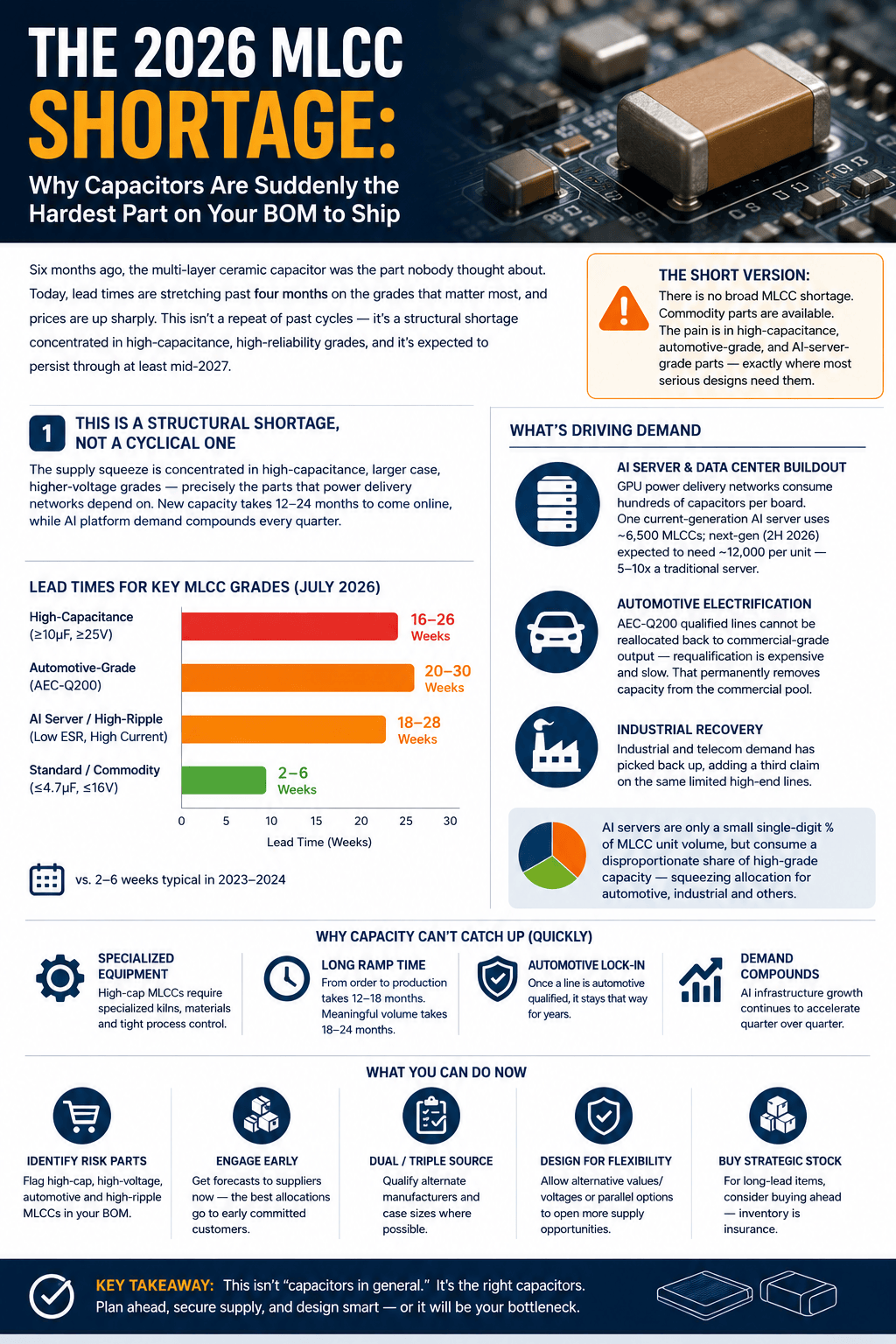
| MLCCs | EVs (10k/unit), smartphones | 20–30 weeks | Elevated, recovering | High |
| Analog ICs (op-amps, ADCs) | Industrial sensors, medical | 26–40 weeks | +15–85% (TI Apr 2026) | High |
| Legacy logic (74xx, CD4000) | End-of-life, no new fabs | Backlogged indefinitely | Spot premiums | High |
| Tantalum / high-V MLCCs | Defense, aerospace programs | 30–52 weeks | Firm | High |
| NAND Flash | AI edge devices, enterprise SSD | 16–24 weeks | +45% YoY revenue | Moderate |
| Passives (resistors, caps) | Broad demand recovery | 8–16 weeks | Relatively stable | Watch |
Lead time trends: then vs. now
The speed of deterioration since early 2026 has caught many procurement teams off guard. Several categories that were comfortably in-stock through most of 2025 have lurched back into allocation territory.
What's driving this wave
AI infrastructure is consuming everything upstream
The scale of data center investment since 2023 has no real precedent. Logic ICs, high-bandwidth memory, interface chips, and optical interconnect components are being consumed at rates that leave traditional industrial and commercial buyers competing for what remains. Memory producers — Samsung, SK Hynix, and Micron — are collectively prioritizing long-term agreements with hyperscalers, leaving smaller manufacturers with fewer options and less predictable lead times.
EV electrification hasn't slowed
EV penetration in major markets is projected to exceed 35% in 2026. Each EV requires 3–5× more semiconductors than a combustion vehicle — particularly SiC MOSFETs, gate drivers, and high-reliability MCUs. Automotive buyers, backed by multi-year supply agreements, are claiming capacity that analog and discrete suppliers must now share with industrial customers.
Tariff-driven front-loading compressed spot availability
US–China trade tensions have reshaped procurement behavior throughout 2025 and into 2026. When tariffs are announced or rumored, rational buyers pull purchases forward. This compressed available supply and drove spot market premiums — in some categories to 2–5× book price — almost overnight.
End-market demand pulling components in all directions
Sourcing actions to take now
| Action | Why it matters | Priority |
|---|---|---|
| Audit BOM exposure | Identify every line item from TI, ADI, Infineon, STMicro, or Nexperia. Quantify cost and availability risk immediately. | Urgent |
| Lock in SiC allocation | ON Semi and Infineon SiC capacity is sold to automotive OEMs first. Without a long-term agreement, spot options only. | Urgent |
| Build 6–12 months safety stock | Especially for strategic passives and legacy logic families with no second-source alternatives. | High |
| Qualify second sources now | Pin-compatible alternatives for 74xx, MCU families, and commodity analog ICs reduce single-supplier risk significantly. | High |
| Treat memory pricing as a floor | Procurement teams sourcing DRAM and NAND should not expect spot market relief before 2027. Price in current rates. | High |
| Monitor rare earth supply | Tight rare earth availability is creating upstream pressure on RF and high-frequency components — an emerging risk to watch. | Monitor |