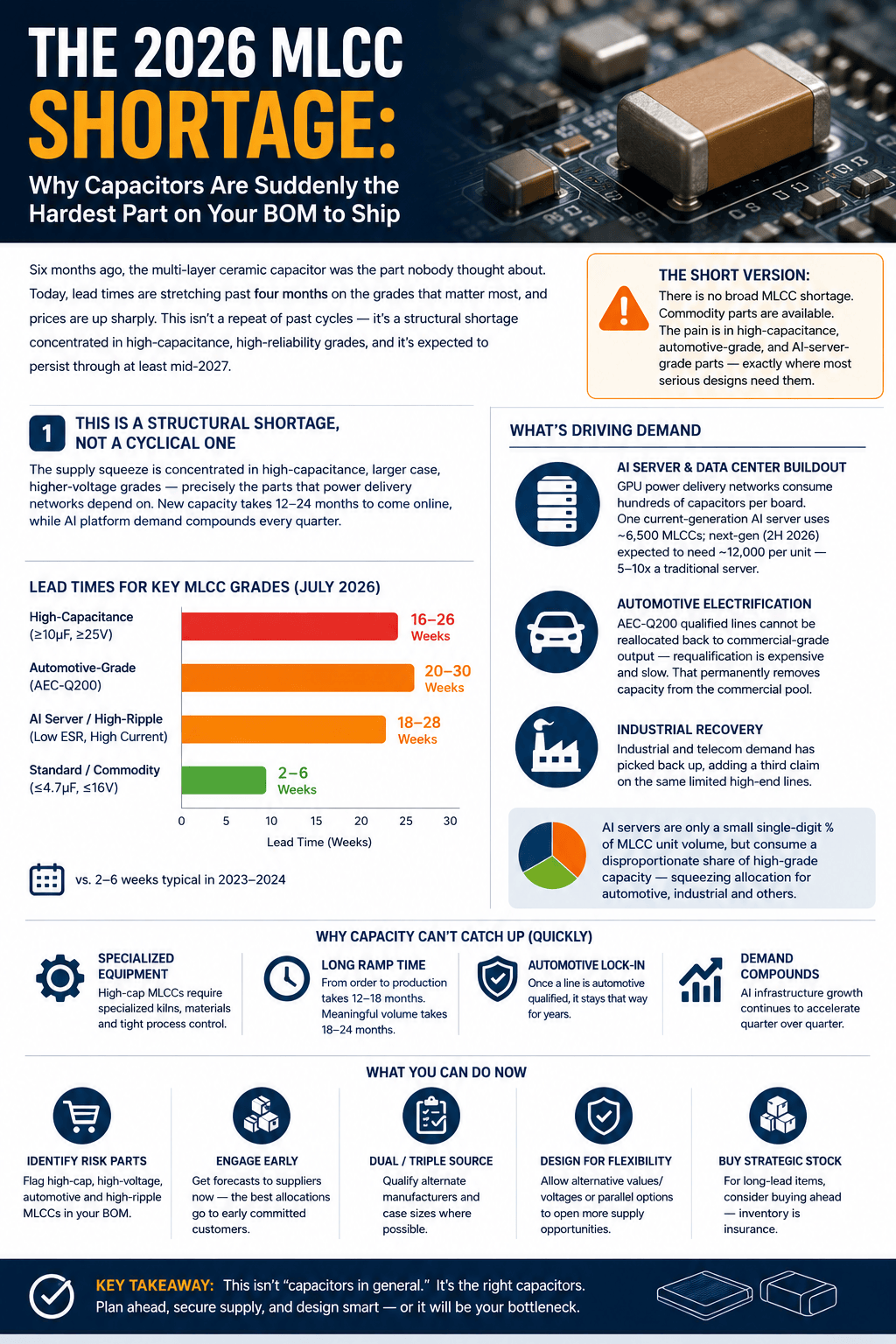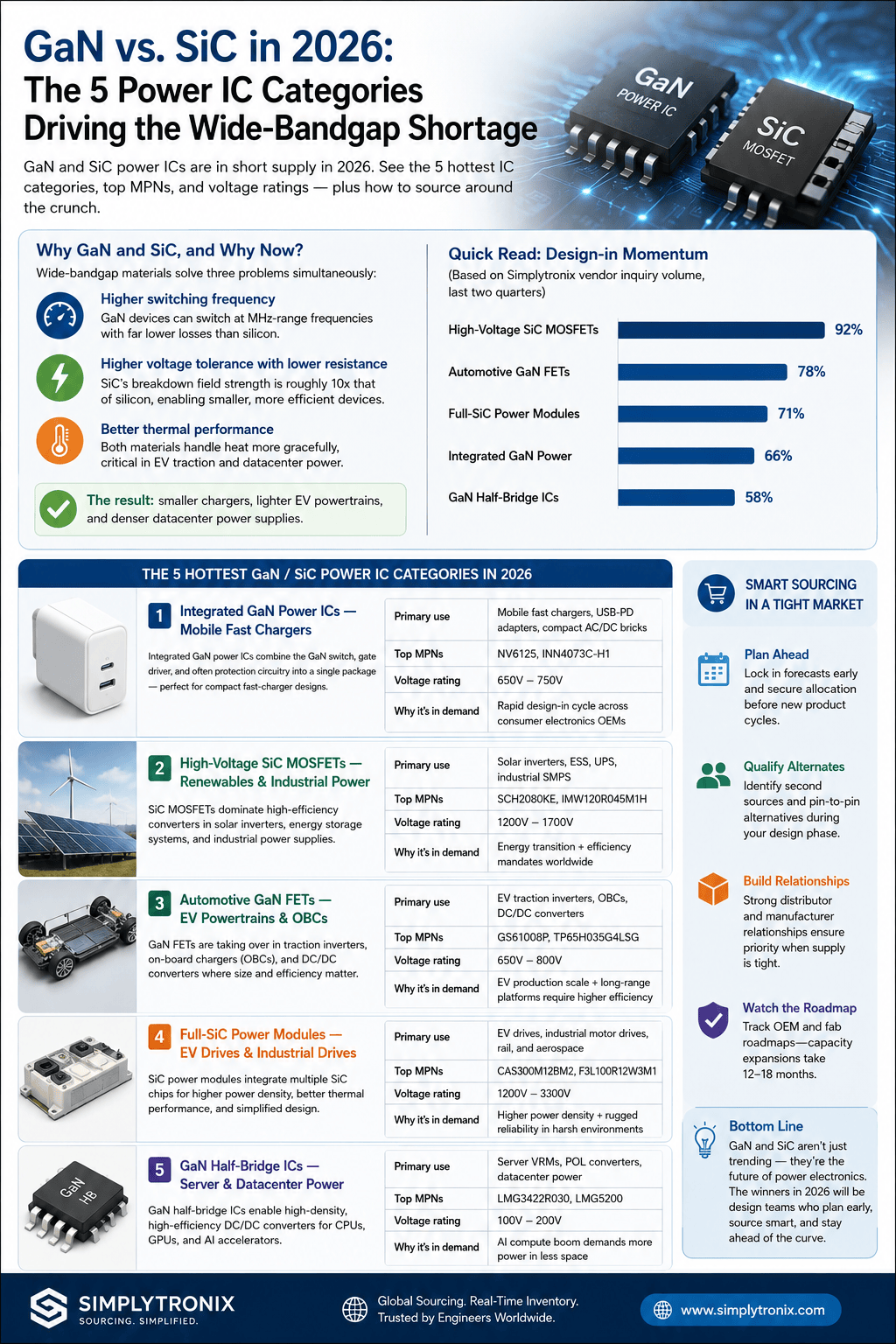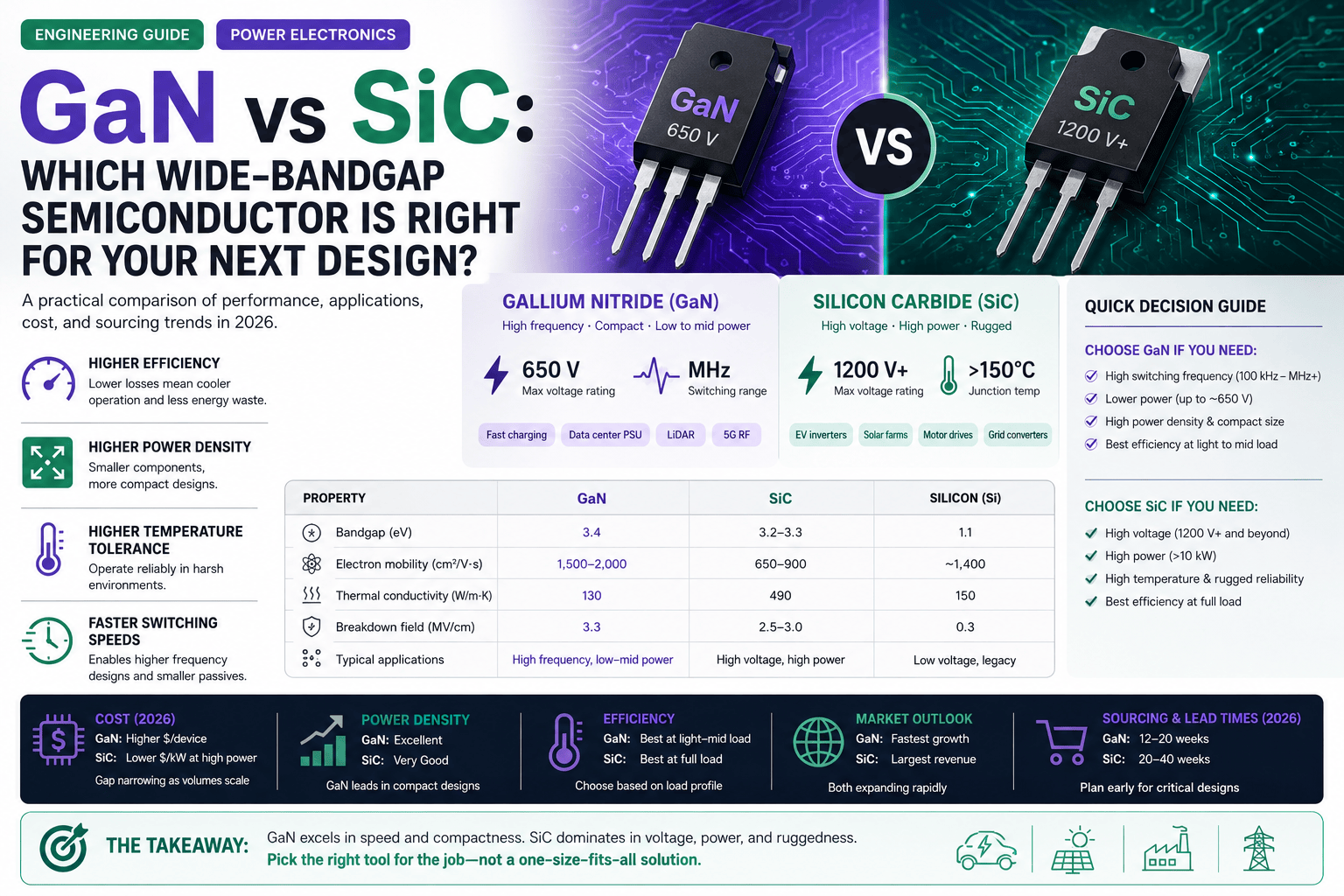
If you're a buyer or design engineer who lived through 2021, you probably think you know what a component shortage looks like: everything's backordered, everyone's panicking, and eventually it passes. 2026 doesn't look like that. This time the shortage is selective, it's being driven by an industry that doesn't even buy the same parts you do, and it's showing up in categories that felt completely safe eighteen months ago. Here's what's actually happening, which parts are at the greatest risk, and how procurement teams are adjusting.
Why This Cycle Feels Different
The 2021–2023 shortage was broad and blunt. Almost everything was hard to get, for roughly the same reasons: pandemic-disrupted fabs, freight chaos, and a demand spike nobody forecasted. By 2024–2025, things loosened up enough that a lot of procurement teams quietly went back to just-in-time ordering.
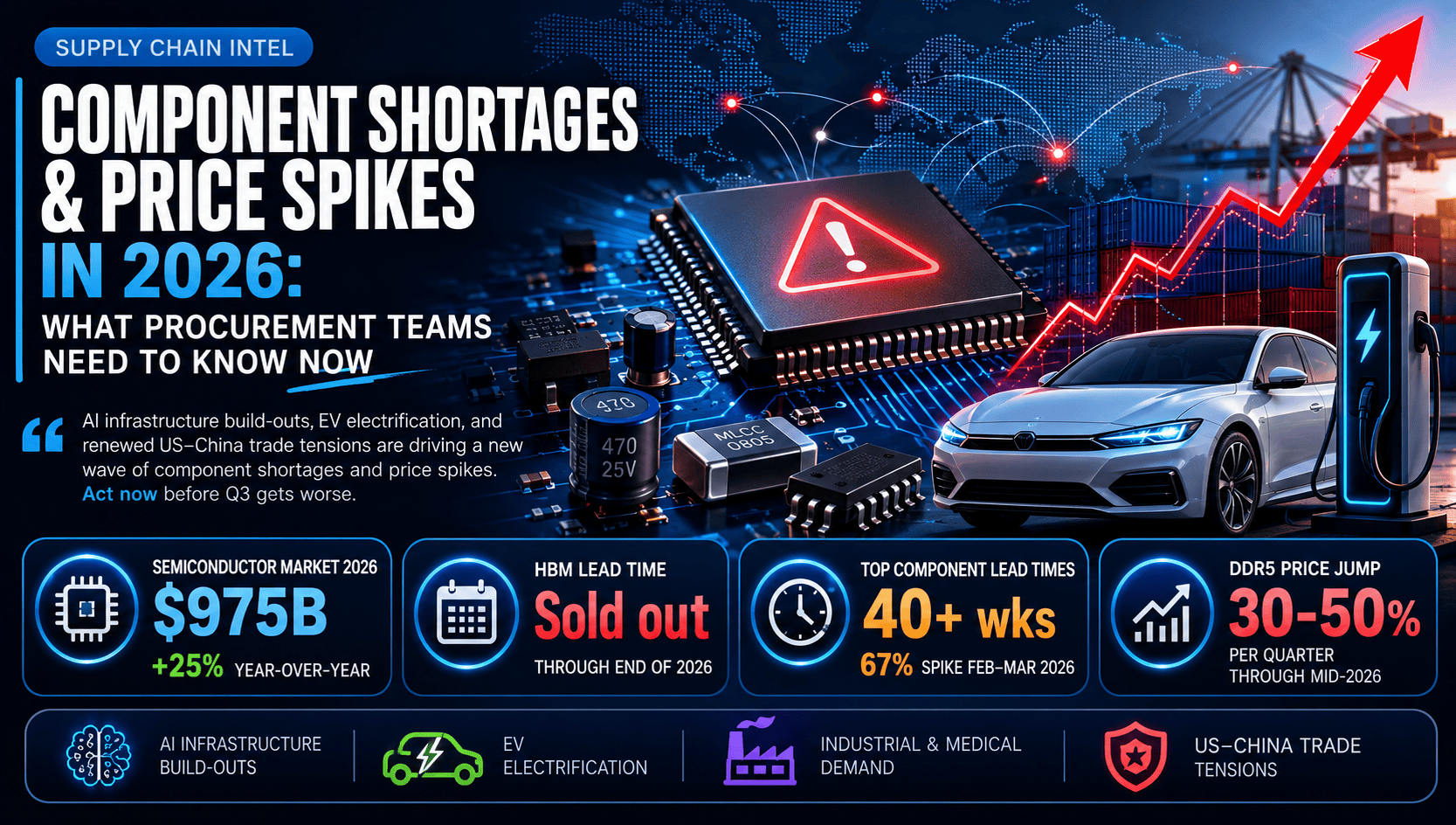
2026 is a different animal. The global semiconductor market is on pace to hit roughly $975 billion this year, up about 25% year-over-year — and almost all of that growth is being pulled by one thing: AI infrastructure. Data centers building out GPU and accelerator capacity are absorbing wafer starts, advanced packaging slots, and — critically — memory supply at a scale that's reshaping how every other industry gets served.
That means the shortage isn't hitting "everything." It's hitting whatever competes with AI hardware for capacity, plus whatever depends on mature-node fabs that manufacturers have quietly stopped investing in because the margins are better elsewhere. If your BOM leans on legacy MCUs, analog ICs, power discretes, or certain passives, you're in the blast radius even if you've never touched anything resembling an AI product.
Where Lead Times Actually Stand Right Now
Lead times are moving fast enough that any number is a snapshot, not a promise — but the current picture, pulled from distributor and manufacturer reporting across Q1–Q2 2026, looks like this:
| Category | Typical Lead Time (2026) | Trend vs. Late 2025 | Primary Driver |
|---|---|---|---|
| General-purpose MCUs (mainstream vendors) | 12–20 weeks | Stable to slightly up | Allocation tightening, not shortage |
| Automotive-grade / AEC-Q100 MCUs (32-bit) | 40–55+ weeks | Sharply up | EV demand + mature-node fab reallocation |
| Power ICs / PMICs | 20–30 weeks | Up | AI data center power delivery competing directly with industrial buyers |
| SiC MOSFETs & IGBT modules | 20–30 weeks, spot pricing 2–5x list | Up, volatile | EV traction inverters + grid/solar buildout |
| DRAM / general memory | Allocation-based, pricing up 90–105% QoQ (Q1 2026) | Sharply up | HBM demand from AI accelerators sold out through year-end |
| Discrete transistors, logic (Nexperia-dependent lines) | Frozen / severely constrained | Sharply up | Export-control-driven wafer supply halt since Oct 2025 |
| Precision analog (op-amps, ADCs, DACs, voltage refs) | Elevated, allocation reintroduced | Up | Industrial sensor & medical device demand |
| Legacy logic (74xx, CD4000 families) | Backlogged / many EOL | Up | Fabs deprioritizing low-margin mature-node lines |
Figures reflect distributor- and manufacturer-reported averages current as of Q1–Q2 2026 and can shift week to week — treat them as directional, not contractual.
Lead Time Spread, Visualized
The AI Effect: Why Your MCU Order Is Competing With a GPU Cluster
This is the part that catches most procurement teams off guard: your components aren't just competing with other buyers in your industry. They're competing with hyperscale data center buildouts for the same fabs, the same packaging lines, and in some cases the same raw wafer starts.
A few concrete mechanisms worth understanding:
- Wafer allocation gets reprioritized toward higher-margin products. When a fab has to choose between running a batch for an AI accelerator customer at premium pricing or a mature-node batch for an industrial MCU customer, the AI order tends to win the queue.
- Memory is the sharpest edge of this right now. High-bandwidth memory used in AI accelerators is essentially sold out for the remainder of 2026, and that scarcity is dragging general DRAM pricing up with it — general and PC DRAM pricing both rose sharply quarter-over-quarter in early 2026.
- Packaging capacity is a bottleneck even where wafers exist. Advanced packaging lead times are running around ten weeks industry-wide, which means a part can clear the fab and still sit waiting for assembly.
- Manufacturers are raising prices faster than they're extending lead times. Several major suppliers have announced double-digit to double-digit-plus price increases effective in Q1/Q2 2026 on power switches, analog ICs, and MCU families — in some cases with very little advance notice, including on orders already in progress.
Who's Exposed: A Quick Vendor Snapshot
Not every supplier is affected equally, and the gap between vendors within the same category has widened. Here's how the major MCU and power suppliers compared as of Q1 2026:
| Manufacturer | Reported Lead Time Range | Notable Pressure |
|---|---|---|
| NXP Semiconductors | 12–20 weeks | Most accessible of the majors, but distributor inventory remains tight |
| Infineon Technologies | 20–30 weeks | Price increases on power switches/ICs effective April 2026 |
| Texas Instruments | 20–40 weeks | Price increases of 15–85% across affected lines, effective April 2026 |
| Renesas Electronics | 20–45 weeks | Automotive-grade parts at the longer end of the range |
| STMicroelectronics | 55+ weeks (select MCU families) | Among the most constrained major MCU suppliers currently |
| Nexperia | Effectively frozen for many lines | Wafer supply disruption tied to export-control measures since Oct 2025 |
The takeaway isn't "avoid vendor X." It's that single-sourcing on any one manufacturer right now is a much riskier bet than it was even a year ago — a part that's fine today can shift categories within a quarter.
A Practical Playbook for 2026 Procurement
None of this is a reason to panic-buy. It is a reason to change habits that worked fine in a looser market. What's actually working for teams navigating this right now:
- Treat anything above a 26-week standard lead time as shortage risk and start sourcing it across more than one channel immediately, rather than waiting for the first quote to fall through.
- Push blanket POs and long-term forecasts out further than feels natural. Several contract manufacturers are now telling clients to plan purchase orders out to the end of the year rather than the usual quarter-at-a-time cadence.
- Re-qualify second sources for any automotive-grade, SiC, or Nexperia-dependent line item now — not when the line goes down. Cross-qualification takes time your production schedule may not have later.
- Separate "price increase" from "shortage" in your risk tracking. A part can still be available while getting significantly more expensive; budgeting for that is a different problem than finding a substitute.
- Verify open POs against new pricing. With multiple manufacturers pushing through increases mid-quarter — some on orders already placed — a PO written six months ago may not reflect what actually ships.
- Build in traceability and counterfeit screening wherever you widen your sourcing base. The tighter the market, the more counterfeit and gray-market risk shows up in categories that used to be low-risk.
Where a Sourcing-on-Demand Model Actually Helps
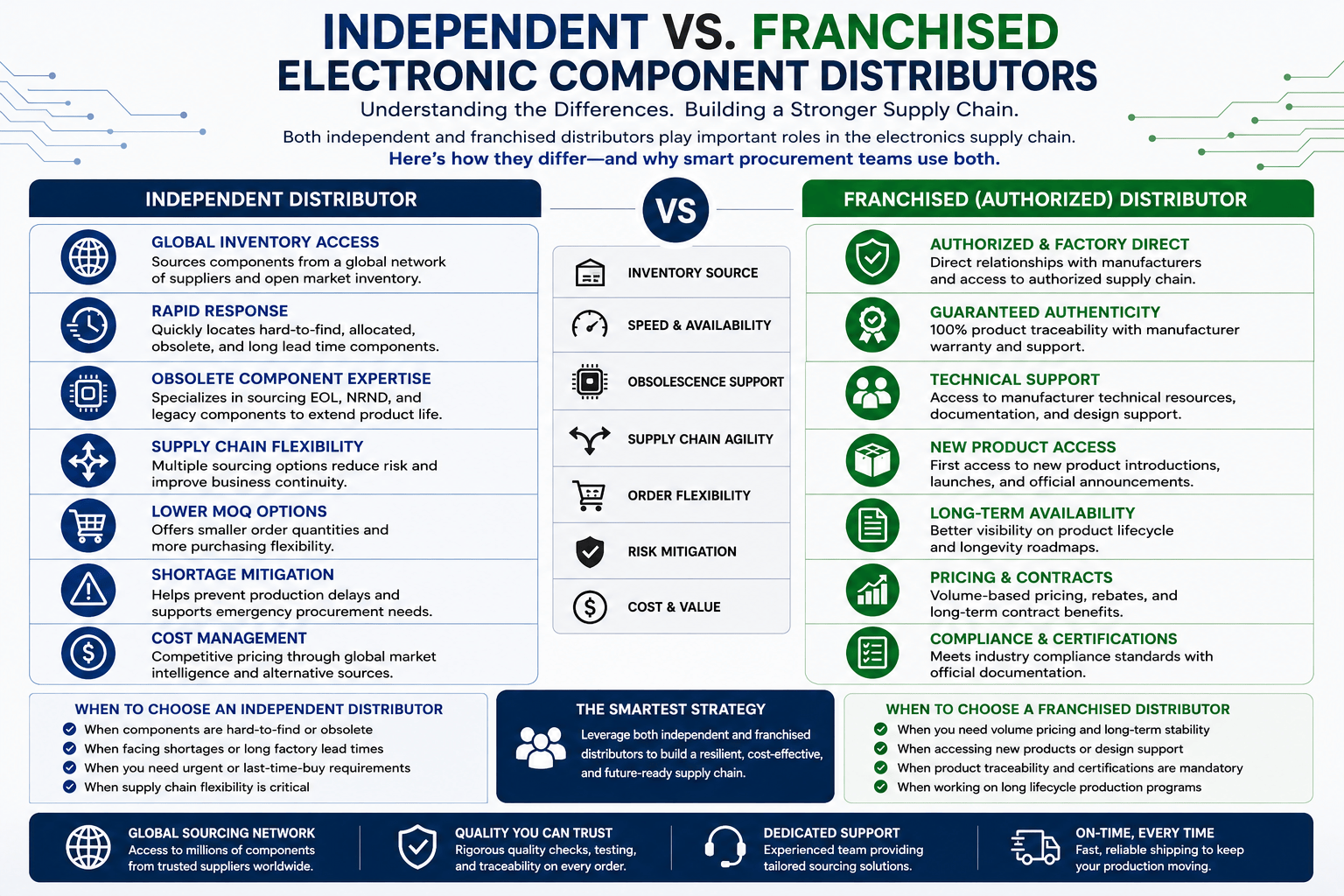
This is exactly the environment independent, sourcing-on-demand distribution exists for. When lead times diverge this sharply by manufacturer and category, the value isn't in warehousing a guess at what you'll need — it's in having the network and the RFQ process to find real stock, verify it, and get it to you fast when your primary channel comes back with a 45-week quote on a part you need in six.
At Simplytronix, that's the entire model: no speculative inventory sitting on shelves going obsolete, just active sourcing against your actual BOM, with the same scrutiny on traceability and authenticity whether the part is easy to find or one we had to work a network to locate. If you're staring down a lead time that doesn't match your production schedule, that's the conversation worth having before the line stops, not after.
The Bottom Line
2026 isn't a repeat of the pandemic shortage, and it's not a false alarm either. It's a structural reshuffling of who gets priority in the world's fabs, driven by an AI buildout that shows no sign of slowing this year. The categories that feel safe today — general-purpose MCUs, mainstream passives — are the ones sitting one capacity decision away from joining the constrained list. The teams handling it best aren't the ones panic-ordering everything; they're the ones who've mapped their real exposure, diversified their sourcing, and built relationships that can move fast when a lead time suddenly doesn't work anymore.
Need help stress-testing your BOM against current lead times, or chasing down a part that's showing 40+ weeks everywhere else? Get in touch with the Simplytronix sourcing team.