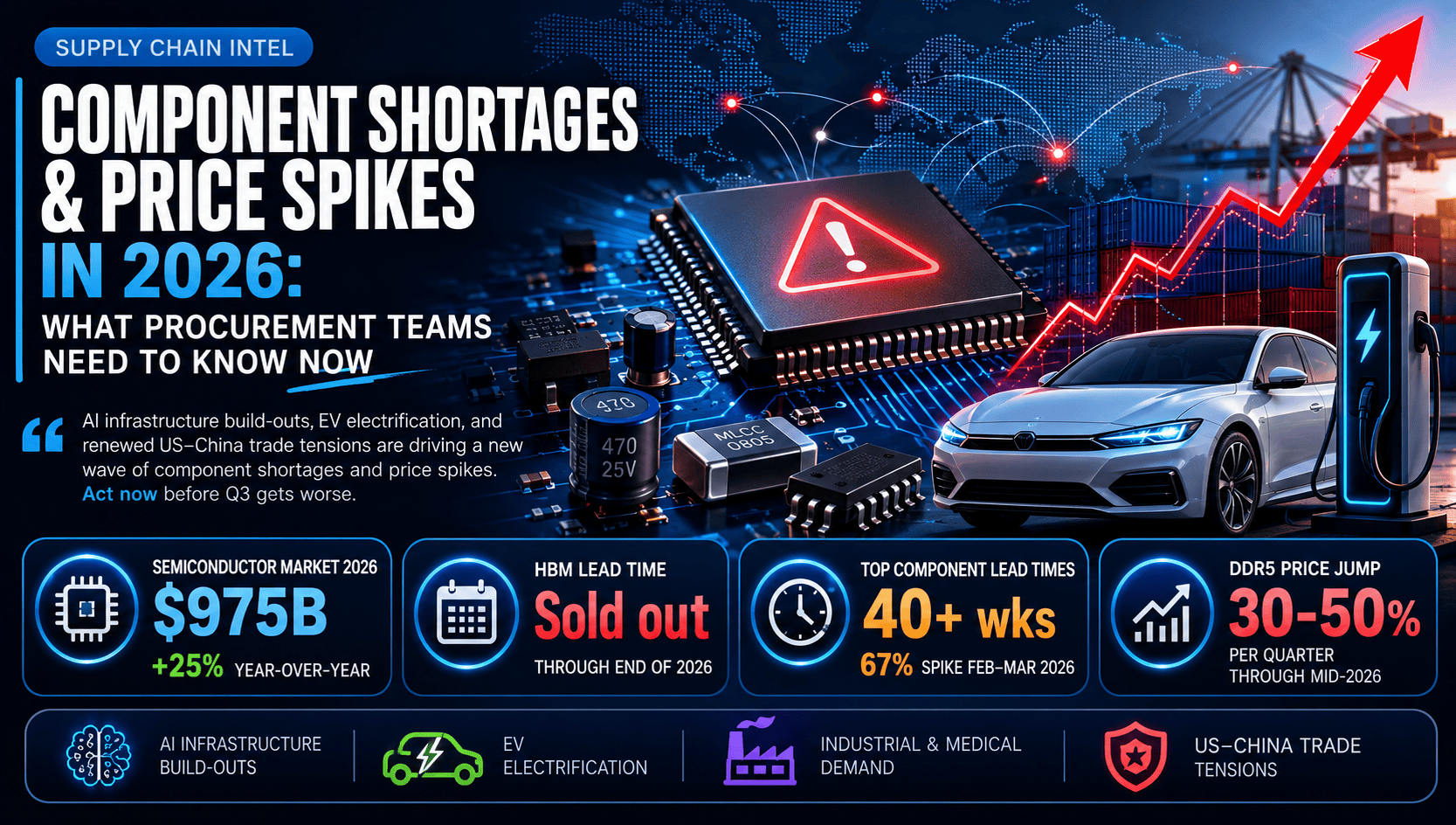
Six months ago, the multi-layer ceramic capacitor was the part nobody thought about. It sat at the bottom of the bill of materials, cost fractions of a cent, and shipped from stock the same week you ordered it. That has changed. Buyers across automotive, industrial, telecom, and consumer electronics are now watching MLCC lead times stretch past four months on the grades that matter most, while quotes on AI-server-grade parts arrive with price increases that would have been unthinkable in 2024.
This isn't a repeat of the broad, everything-is-scarce shortages of 2021. It's narrower, more structural, and in some ways harder to plan around, because it is concentrated in exactly the high-capacitance, high-reliability grades that power delivery networks and automotive modules depend on. Here's what's actually happening, why it's happening, and how sourcing teams are adapting.
1. This Is a Structural Shortage, Not a Cyclical One
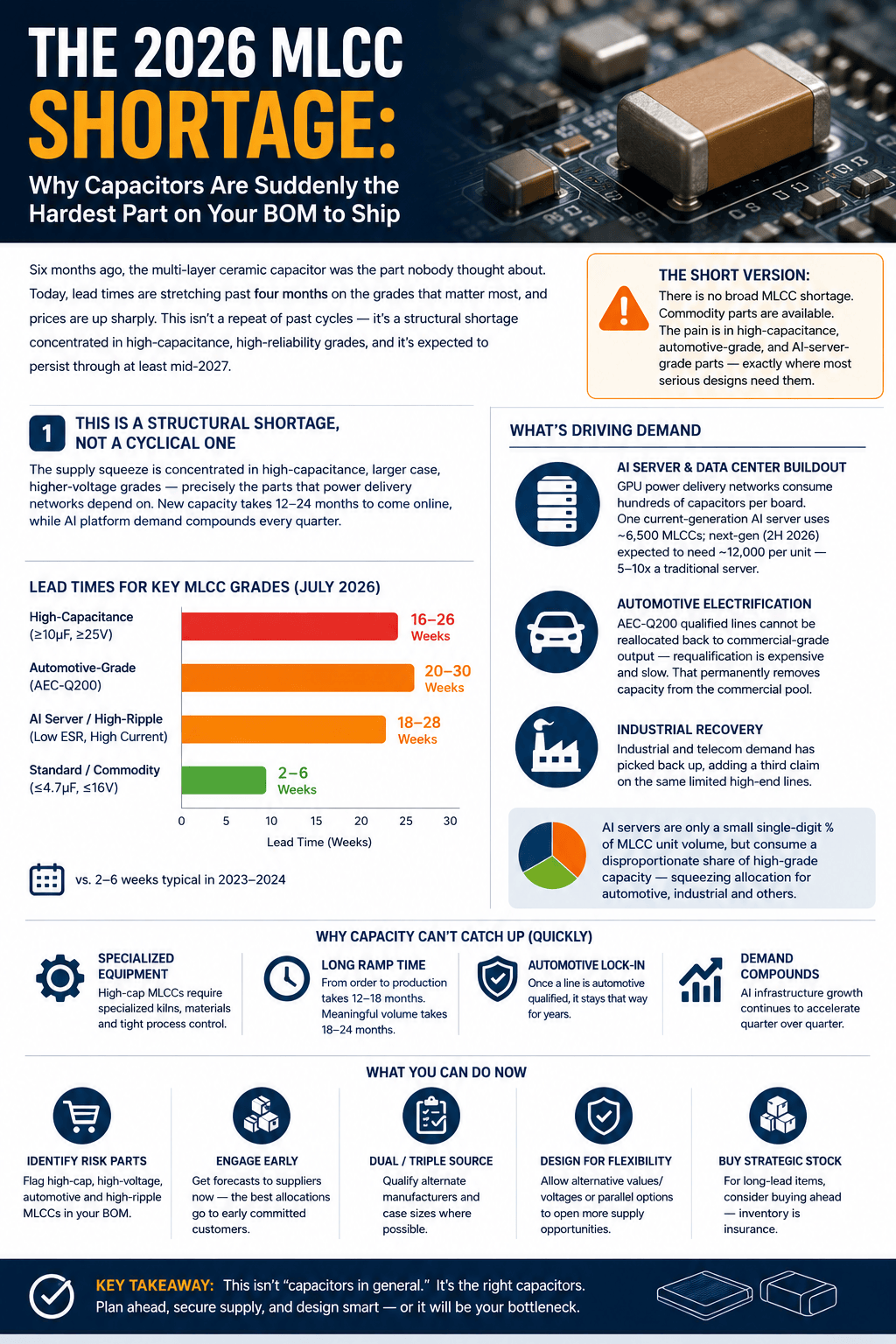
The passive components industry has lived through boom-and-bust capacitor cycles before — most recently in 2017–2018 and again in 2021–2022. Those cycles were driven by demand spikes that eventually cooled as capacity caught up. What's happening in 2026 looks different. The supply squeeze is concentrated in high-capacitance, larger case, higher-voltage grades — precisely the parts that power delivery networks depend on — and analysts expect the constraint to persist through at least mid-2027, because new capacity arrives on a 12-to-24 month cycle while AI platform demand compounds every quarter.
What's driving demand
Three demand sources are converging on the same manufacturing capacity that has historically served general electronics:
- AI server and data center buildout. GPU power delivery networks alone can consume hundreds of capacitors per board, and hyperscaler order volumes dwarf typical enterprise server demand. One current-generation AI server design uses roughly 6,500 MLCCs; the next-generation platform arriving in the second half of 2026 is expected to need around 12,000 per unit — five to ten times the volume of a traditional server.
- Automotive electrification. Once a production line is qualified to the AEC-Q200 automotive standard, manufacturers will not reallocate it back to commercial-grade output, because requalification is expensive and slow. That permanently removes capacity from the commercial pool.
- General industrial recovery. Industrial and telecom demand has picked back up at the same time, adding a third claim on the same limited high-end lines.
The result: although AI servers account for only a small single-digit percentage of total MLCC unit volume, they consume a disproportionate share of high-grade capacity, squeezing allocation for everyone else building automotive or industrial products on the same production lines.
2. Where the Capacity Actually Sits
Unlike semiconductors, where dozens of foundries compete for wafer starts, high-end MLCC capacity is concentrated in a handful of tier-one manufacturers. Murata and Samsung Electro-Mechanics (SEMCO) dominate, with Taiyo Yuden and Kyocera behind them. Combined, the top three control roughly three-quarters of global high-end MLCC capacity, and utilization on those lines is running at 90–95%, leaving essentially no buffer for a demand surge.
New capacity is coming, but not quickly. Murata's server-focused expansion is not expected to reach mass production until the fourth quarter of 2026, while SEMCO's high-end capacity ramp has slipped to the first quarter of 2027. High-grade fabs require roughly a year and a half to two years to build, plus another year or more for precision equipment delivery and yield optimization — so even fully-funded expansion announced today won't meaningfully ease the market until well into next year.
3. Lead Times and Pricing: The Numbers
The clearest signal of how tight the market has become is the spread between lead times on commodity parts and lead times on the grades everyone actually needs.
| MLCC category | Historical lead time | Mid-2026 lead time | Price change since Feb 2026 |
|---|---|---|---|
| Commodity-grade, common case sizes | 6–8 weeks | 8–12 weeks | Roughly flat, modest increases on select values |
| High-capacitance / larger case, standard voltage | 6–8 weeks | 16–20+ weeks | +15% to +20% |
| Ultra-high-cap / AI-server-grade | 6–8 weeks | 26–40 weeks | +50% to +60% |
| Automotive-grade (AEC-Q200, X7R/X8R) | 8–10 weeks | 18–24 weeks | +6% to +13% |
Channel inventory tells the same story. Distributor stock on the tight grades is estimated at just one to one-and-a-half months of coverage, compared with a historical average closer to four and a half months. That thin buffer means even a modest order surprise — a large hyperscaler pulling forward an order, or a Tier 1 automotive supplier topping off safety stock — can push an already-long lead time out further with little warning.
What manufacturers are doing on price
Taiyo Yuden was among the first to move, raising prices on low-capacitance consumer and automotive MLCCs by 6–13% in April 2026. Murata has since run two rounds of price adjustments specifically on AI-grade high-end parts. Industry forecasts point to further increases in the second half of 2026 — on the order of 20–30% for general high-capacitance grades and 30–50% for ultra-high-capacitance grades — tracking the ramp of next-generation AI server platforms expected in Q3–Q4.
"The divergence between AI-driven demand and general industrial recovery is creating a dangerous procurement gap for standard hardware manufacturers. Firms must secure allocations for high-capacitance MLCCs now, as lead times will likely deteriorate further when automotive demand aligns with the current server build-out."
4. Why Supply Can't Just Catch Up
It's worth being direct about the mechanics here, because they explain why this isn't a shortage that resolves in a quarter or two:
- Capacity expansion is slow by nature. Building a new precision MLCC line involves cleanroom construction, specialized ceramic-forming and firing equipment, and a lengthy yield-optimization period before output is usable at automotive or AI-grade reliability specs. The whole cycle typically runs 12–24 months from capital decision to shipped product.
- Line conversion is a one-way door in practice. Once a line is qualified for AEC-Q200 automotive output, manufacturers have little incentive to convert it back to commercial-grade production, even during a commercial-grade squeeze, because requalification costs and lost automotive revenue make it unattractive.
- Manufacturers are prioritizing the highest-margin business. AI-specific grades carry substantially higher margins than commodity parts, so when a line can run either, capacity gets allocated toward AI-server orders first.
- Demand is compounding, not spiking once. This isn't a single order surge working through the system. Every quarter of new AI accelerator deployment adds another slice of structural demand on top of the last, so the target keeps moving.
5. What This Means If You're Sourcing Right Now
For a distributor or OEM buyer, the practical question isn't "will this get better soon" — the honest answer is not before early-to-mid 2027 on the tightest grades. The practical question is how to keep production running in the meantime. A few patterns are showing up across the industry:
Design and engineering side
- Widen parameter windows on the next board spin. If a design specifies a tight-tolerance, large-case, high-capacitance part where a slightly different case size or voltage rating would work electrically, giving engineering that flexibility opens up alternate sourcing paths immediately.
- Add footprint flexibility. Designing pads that can accept two or three case sizes for the same net gives purchasing room to substitute without a re-spin when one grade is unavailable.
- Qualify second sources early. Waiting until a part goes end-of-life or unallocated to find an alternate is now too late; qualification needs to happen ahead of the shortage biting, not after.
Procurement and inventory side
- Move away from pure just-in-time ordering on critical passives. Sourcing strategies across the industry are shifting toward longer-term agreements and forward positions on the tight grades specifically, rather than ordering to the immediate production schedule.
- Verify availability weekly, not quarterly. With channel inventory this thin, a quote that was valid a month ago may no longer reflect real allocation. Teams checking live distributor stock weekly are catching allocation changes before they turn into line-down events.
- Lock pricing on commodity grades before increases land. Even parts not directly affected by the high-cap squeeze are seeing knock-on price pressure as manufacturers rebalance product mix toward higher-margin lines.
- Prioritize by criticality, not by unit cost. The cheapest line item on the BOM is once again the one most likely to stop production. A five-cent capacitor with a 30-week lead time is a bigger schedule risk than a five-dollar IC with an eight-week lead time.
6. How This Plays Out by Industry
The squeeze doesn't land the same way on every buyer. A few patterns are worth calling out for teams trying to gauge their own exposure:
Automotive and industrial
Automotive buyers are exposed twice over. They compete for the same tight high-capacitance grades as AI server builders, and separately they're locked into automotive-qualified lines that manufacturers won't reallocate even when commercial demand eases. Industrial equipment makers sit in a similar position whenever their designs lean on X7R/X8R grades originally chosen for temperature stability rather than availability. For both groups, the practical fix is usually the same one engineering teams have used in past passive shortages: requalify designs against a wider set of approved manufacturers, rather than single-sourcing to whichever supplier happened to have the best price two years ago.
Consumer electronics and general commercial hardware
This segment is in a genuinely better position than the headlines suggest. Commodity-grade MLCCs in common case sizes and standard capacitance values remain broadly available, and lead times, while stretched from historical norms, are nowhere near the 20–40 week range seen on high-cap and AI-grade parts. The risk for this group is less about outright unavailability and more about creeping price increases as manufacturers rebalance product mix toward higher-margin lines, and about knock-on tightness if a design happens to specify a case size or capacitance value that overlaps with what AI server power stages need.
AI infrastructure and hyperscale server builders
This is where the shortage is sharpest, and where it's likely to stay sharpest through 2026. Power delivery networks on GPU boards are capacitor-hungry by design, and the volumes involved in a single hyperscaler order can absorb a meaningful share of a supplier's spare high-end capacity in one purchase order. Buyers in this segment are the ones driving the shift toward long-term supply agreements and forward-booked allocation, because spot-market sourcing on these grades is no longer a reliable fallback.
7. Frequently Asked Questions
Is this the same as the 2021 chip shortage?
Not really. The 2021 shortage was broad and touched nearly every category of active and passive component simultaneously, driven largely by a demand shock during pandemic-era electronics buying. The 2026 MLCC situation is narrower and structural — it's concentrated in specific high-capacitance and automotive grades, driven by a genuine step-change in how many capacitors AI server power stages require, layered on top of steady automotive and industrial demand.
Will prices come back down?
On commodity grades, prices are expected to stay roughly stable with only modest movement. On high-capacitance and AI-server grades, most industry forecasts point to further increases through the second half of 2026 before any stabilization, since new capacity won't meaningfully land until Q4 2026 into 2027 at the earliest.
What can a smaller buyer actually do about allocation?
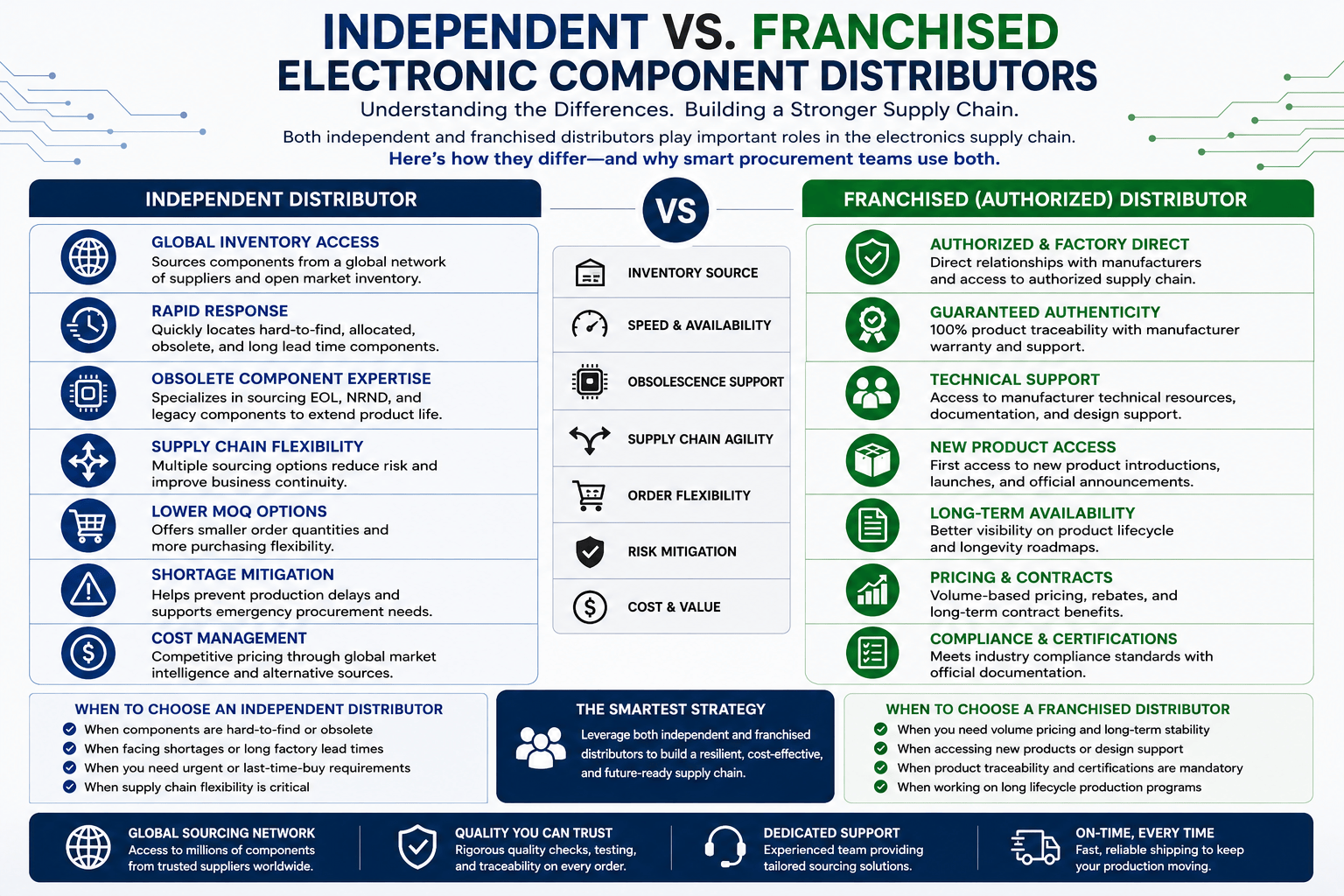
Smaller buyers rarely get direct allocation conversations with Murata or SEMCO the way hyperscalers do, but they aren't powerless. Working through a distributor or sourcing partner that tracks live stock across multiple authorized and open-market channels, qualifying alternate case sizes and manufacturers in the design phase, and placing orders earlier relative to the production schedule all meaningfully reduce exposure, even without the purchasing leverage of a large OEM.
8. Outlook: What to Watch Through 2027
A few milestones will signal whether the market is genuinely easing or just plateauing:
| Milestone | Expected timing | Likely effect |
|---|---|---|
| Murata's new server-focused capacity reaches mass production | Q4 2026 | Marginal relief on ultra-high-cap grades, not full resolution |
| SEMCO high-end capacity ramp | Q1 2027 | Additional incremental supply |
| Next-gen AI accelerator platform mass shipments | Q3–Q4 2026 | New demand peak likely to offset early capacity gains |
| Commodity-grade easing as non-optimized lines shift to general production | Late Q4 2026 | Some relief expected on standard-grade parts specifically |
| Broader structural rebalancing | Not before mid-2027 | Full normalization on high-cap and automotive grades |
The realistic planning assumption for most teams: commodity-grade MLCCs should stay manageable, with some easing possible late this year. High-capacitance, AI-grade, and automotive-grade parts should be treated as constrained through at least the first half of 2027, with pricing likely to keep climbing before it stabilizes.
Simplytronix sources electronic components on demand, including allocation-constrained MLCC grades, for customers navigating exactly this kind of supply tightness. If a project is stuck behind a long MLCC lead time, our sourcing team can check live cross-references and alternate distributor stock — reach out through simplytronix.com.