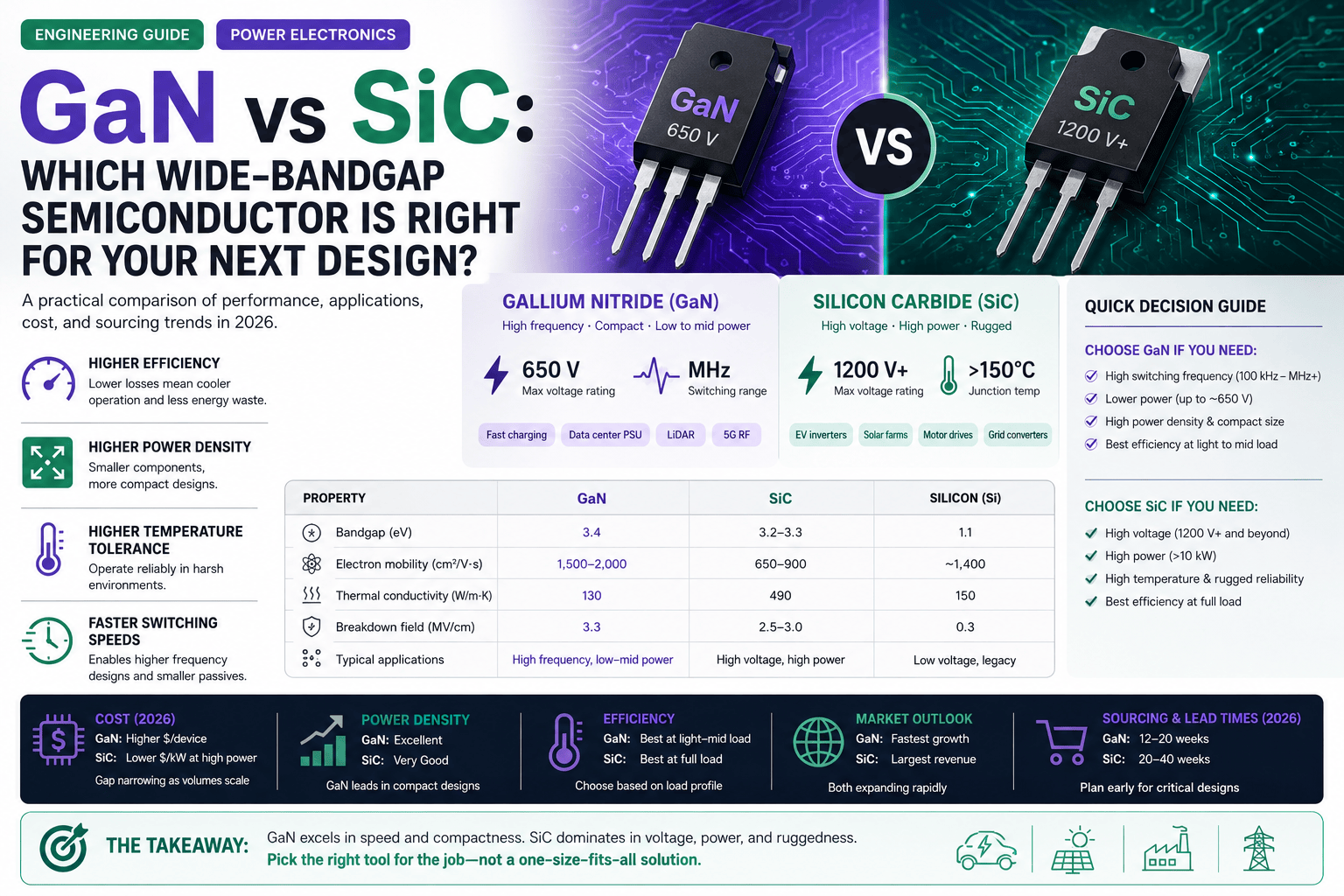
GaN and SiC have both left the lab and entered volume production — but they are not interchangeable. This guide cuts through the marketing noise and gives you the parameters that actually matter when selecting between them for your next design.
Material properties: where the difference begins
Both materials belong to the wide-bandgap (WBG) family, meaning they require significantly more energy to conduct electricity than silicon. That property alone allows them to handle higher voltages, temperatures, and switching speeds — but the materials diverge sharply from there.
| Property | GaN | SiC | Silicon (Si) |
|---|---|---|---|
| Bandgap (eV) | 3.4 | 3.2–3.3 | 1.1 |
| Electron mobility (cm²/V·s) | 1,500–2,000 | 650–900 | ~1,400 |
| Thermal conductivity (W/m·K) | 130 | 490 | 150 |
| Breakdown field (MV/cm) | 3.3 | 3.0 | 0.3 |
| Max switching frequency | MHz range | 100s of kHz | ~20 kHz |
| Max junction temperature | ~150°C (practical) | >175°C | ~150°C |
| Cost premium vs. silicon | 2–3× | 3–5× | Baseline |
The headline number is SiC's thermal conductivity — at 490 W/m·K it is nearly 4× that of GaN and silicon. In high-power designs this is transformative: heat escapes the junction faster, enabling smaller heatsinks and simpler thermal management. GaN's edge is electron mobility, which translates directly into faster switching with lower gate charge — the reason GaN is the go-to for compact, high-efficiency designs where size and weight matter most.
The core decision: voltage and frequency
The simplest way to start your selection is to plot your application on two axes — operating voltage and switching frequency.
Application-by-application breakdown
Market adoption & growth outlook
Both materials are moving rapidly from early adoption into volume deployment. TrendForce predicts adoption of SiC and GaN in data center power systems will reach 17% by 2026 and exceed 30% by 2030. The global power semiconductor market is projected to grow 10–14% in 2026, driven by EV platforms, renewable energy systems, and AI data centers.
Design considerations engineers often overlook
Gate drive requirements differ fundamentally
GaN enhancement-mode devices typically require a negative turn-off voltage (around −5 V) to avoid false turn-on events — something silicon IGBT gate drivers are not designed for. Designing a GaN gate drive from scratch, or selecting a purpose-built GaN gate driver IC, is a non-trivial engineering task requiring new skills for engineers schooled in silicon IGBTs.
PCB layout sensitivity
GaN is highly sensitive to even a few millimeters of added loop length, whereas SiC requires careful planning related to creepage and clearance due to higher voltage operation. At MHz switching speeds, a poorly routed GaN layout introduces parasitic inductance that causes ringing, overshoot, and efficiency losses that completely undermine the device's theoretical advantage.
The thermal management paradox
While GaN and SiC tolerate higher temperatures, their full potential is only realized when kept cool. The best-performing systems often incorporate advanced cooling solutions to push efficiency boundaries further. Don't assume a high-temperature device rating means you can skip the heatsink.
Packaging evolution
Traditional TO-247 packages cannot fully exploit wide-bandgap advantages. New packaging approaches like double-sided cooling and embedded die technologies are becoming essential. When evaluating parts, check whether the package itself is the limiting factor in your thermal or parasitic budget.
Full parameter comparison
| Parameter | GaN | SiC | Verdict |
|---|---|---|---|
| Voltage range | Up to 650 V | Up to 1700 V | SiC for HV |
| Switching frequency | MHz range | 100s of kHz | GaN for speed |
| Conduction losses | Very low Rds(on) | Low Rds(on) | GaN edge |
| Thermal performance | Good (130 W/m·K) | Excellent (490 W/m·K) | SiC wins |
| Form factor / density | Smaller passives | Larger but robust | GaN compact |
| Gate drive complexity | Higher (−5 V turn-off) | Moderate | SiC simpler |
| PCB layout sensitivity | Very high | Moderate | SiC forgiving |
| Supply chain maturity | Maturing | More established | SiC advantage |
| Cost premium vs. Si | 2–3× | 3–5× | GaN cheaper |
| Automotive qualification | AEC-Q101 emerging | AEC-Q101 mature | SiC for auto |
Sourcing these parts today
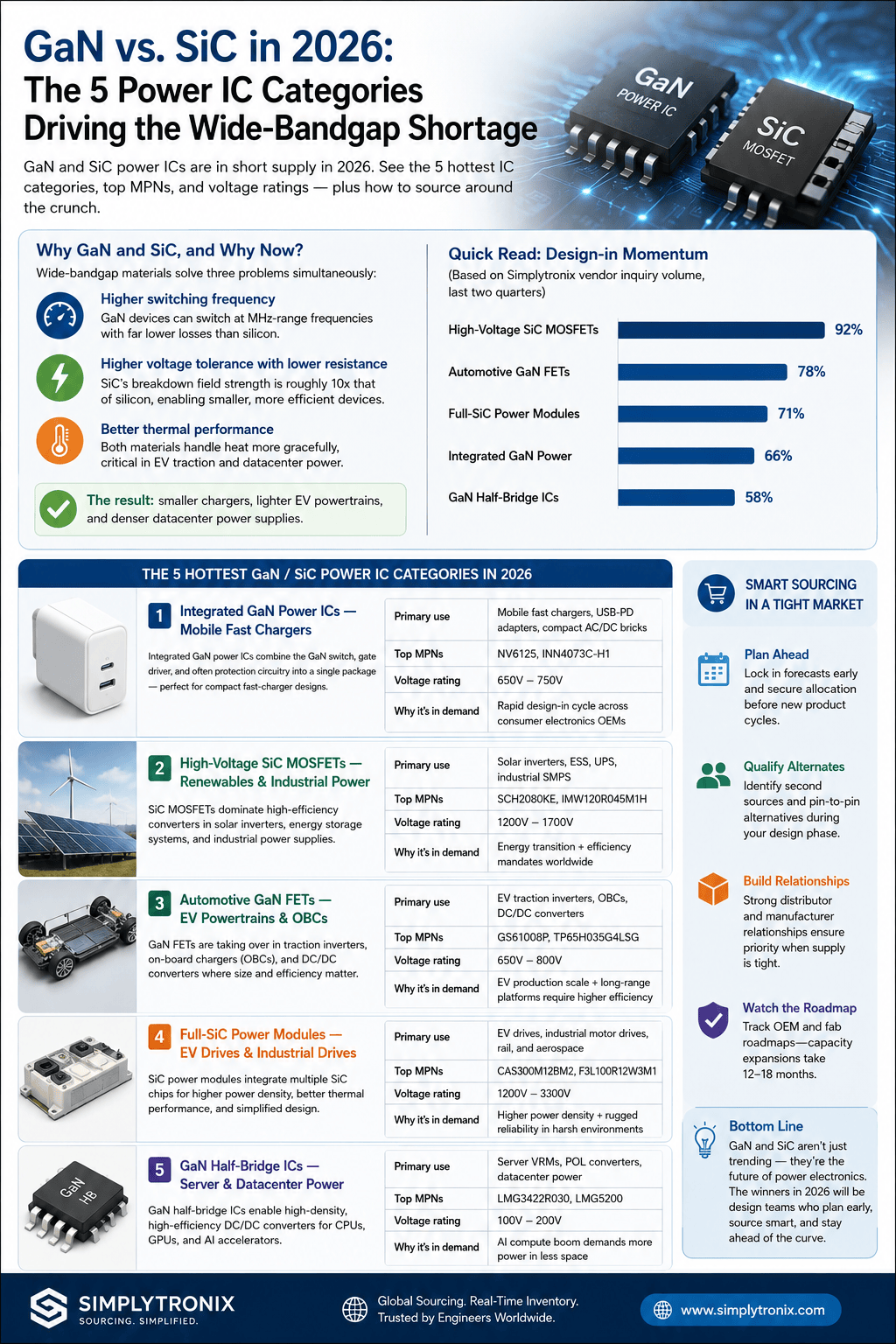
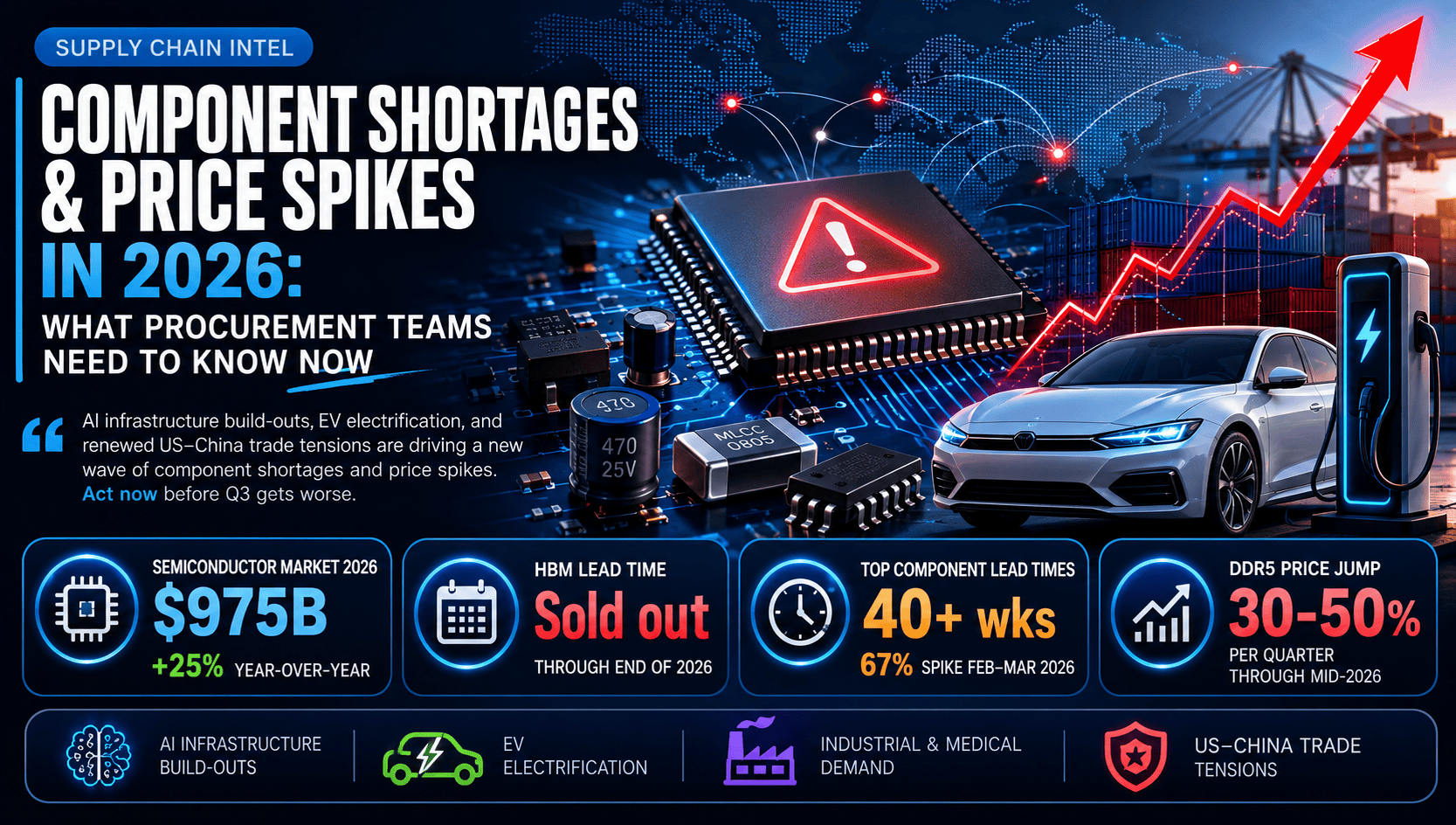
Both GaN and SiC devices are under allocation pressure in 2026, particularly automotive-grade SiC from ON Semiconductor and Infineon. Key suppliers to know:
| Technology | Key supplier | Notable families | Availability note |
|---|---|---|---|
| SiC MOSFET | ON Semiconductor | EliteSiC, NTH series | Allocation — EV priority |
| SiC MOSFET | Infineon | CoolSiC MOSFET 1200V | Long lead times |
| SiC MOSFET | STMicroelectronics | SCT series | Selective availability |
| GaN FET | GaN Systems / Infineon | GS-065, CoolGaN | Generally available |
| GaN FET | Texas Instruments | LMG341x, LMG351x | Stock at distribution |
| GaN FET | Navitas / EPC | NV6247, EPC2218 | Good availability |