
Modern electronics would not exist without MOSFETs. From smartphones and laptops to industrial automation systems and electric vehicles, MOSFETs play a major role in controlling and switching electrical power efficiently.
In this guide by Simplytronix, we will explain what a MOSFET is, how it works, its types, advantages, applications, and how engineers select the right MOSFET for different electronic designs.
What Does MOSFET Stand For?
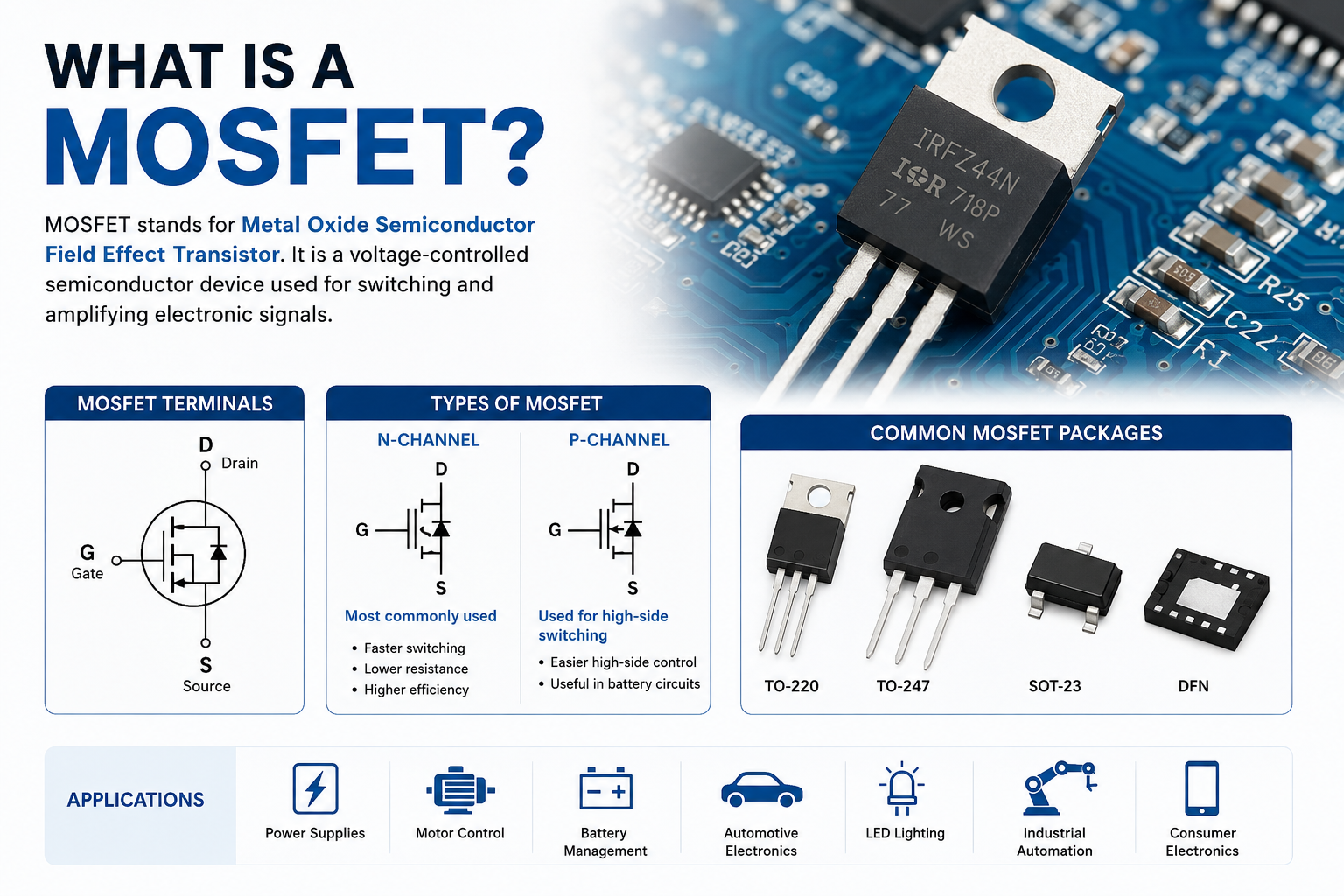
MOSFET stands for:
Metal Oxide Semiconductor Field Effect Transistor
A MOSFET is a semiconductor device mainly used for:
- Electronic switching
- Signal amplification
- Power management
- Voltage regulation
- Motor control
- High-speed digital circuits
MOSFETs are voltage-controlled devices, meaning a small voltage applied at the gate terminal can control a much larger current flow between the drain and source.
Because of their efficiency and fast switching capability, MOSFETs are among the most widely used transistors in modern electronics.
Basic Structure of a MOSFET
A MOSFET typically contains three primary terminals:
1. Gate (G)
Controls the MOSFET operation.
2. Drain (D)
Current enters or exits through this terminal.
3. Source (S)
Current flows out or into this terminal.
Some MOSFETs also include a fourth terminal called the substrate or body terminal, which is generally internally connected.
How Does a MOSFET Work?
A MOSFET functions like an electronic switch.
When voltage is applied to the gate:
- The MOSFET turns ON
- Current flows between drain and source
When gate voltage is removed:
- The MOSFET turns OFF
- Current stops flowing
This simple switching behavior makes MOSFETs ideal for power electronics and digital circuits.
Simple Analogy
Think of a MOSFET like a water valve:
- Gate = Handle
- Drain = Water inlet
- Source = Water outlet
Turning the handle controls water flow, just like gate voltage controls electrical current.
Types of MOSFETs
MOSFETs are mainly divided into two categories.
1. Enhancement Mode MOSFET
This is the most common type.
Features:
- Normally OFF
- Requires gate voltage to turn ON
- Widely used in switching applications
Types:
- N-Channel MOSFET
- P-Channel MOSFET
2. Depletion Mode MOSFET
Features:
- Normally ON
- Requires voltage to turn OFF
- Less commonly used
N-Channel vs P-Channel MOSFET
N-Channel MOSFET
N-Channel MOSFETs are more popular because they offer:
- Faster switching
- Lower resistance
- Better efficiency
- Higher current capability
Common applications include:
- Switching power supplies
- DC motor drivers
- Battery-powered devices
- Automotive electronics
- Industrial automation
Popular MOSFET part numbers:
- IRFZ44N
- IRLZ44N
- AO3400A
- SI2302
P-Channel MOSFET
P-Channel MOSFETs are often used for:
- High-side switching
- Battery protection circuits
- Power distribution systems
- Portable electronics
Popular part numbers:
- IRF9540N
- AO3401A
Important MOSFET Parameters
1. Drain-Source Voltage (VDS)
The maximum voltage the MOSFET can safely handle.
2. Drain Current (ID)
The maximum current capacity of the MOSFET.
3. RDS(ON)
The internal resistance when the MOSFET is ON.
Lower RDS(ON) results in:
- Less heat generation
- Higher efficiency
- Lower power loss
4. Gate Threshold Voltage (VGS(th))
The minimum gate voltage required to activate the MOSFET.
5. Power Dissipation
The amount of power the MOSFET can safely dissipate without damage.
Applications of MOSFETs
1. Switching Power Supplies
MOSFETs are heavily used in SMPS circuits for efficient power conversion.
2. Motor Control
Used in:
- BLDC motors
- Robotics
- Electric vehicles
- Industrial automation
3. Battery Management Systems
MOSFETs help control charging and protect batteries from overcurrent conditions.
4. Automotive Electronics
Modern vehicles use MOSFETs in:
- Infotainment systems
- ADAS modules
- Lighting systems
- Electronic control units
- EV powertrains
5. Consumer Electronics
MOSFETs are found in:
- Smartphones
- Laptops
- Gaming systems
- LED TVs
- Power banks
Advantages of MOSFETs
- High switching speed
- Low power consumption
- Excellent efficiency
- Compact size
- Reduced heat generation
- Long operational life
- Reliable performance
Common MOSFET Packages
Through-Hole Packages
- TO-220
- TO-247
Used in high-power applications requiring heat sinks.
Surface Mount Packages
- SOT-23
- SOIC
- DFN
- PowerPAK
Commonly used in compact and portable electronics.
How to Select the Right MOSFET
When choosing a MOSFET, engineers consider:
- Voltage rating
- Current rating
- RDS(ON)
- Switching speed
- Thermal performance
- Package type
Selecting the correct MOSFET improves reliability, efficiency, and overall circuit performance.
Future of MOSFET Technology
Advanced semiconductor technologies such as Silicon Carbide (SiC) MOSFETs and Gallium Nitride (GaN) MOSFETs are enabling:
- Faster charging systems
- Higher efficiency power supplies
- Compact electronics
- Advanced EV systems
- Improved industrial automation
These next-generation MOSFETs are shaping the future of power electronics.
Final Thoughts
MOSFETs are among the most important semiconductor components used in modern electronics. Their ability to efficiently switch and control electrical power makes them essential in consumer electronics, industrial systems, automotive applications, and renewable energy solutions.
Whether you are designing embedded systems, robotics projects, power supplies, or automotive electronics, understanding MOSFETs is essential for building efficient and reliable circuits.
Explore high-quality semiconductor components and electronic parts at Simplytronix for your next electronics project.