The global electronics industry continues experiencing a major challenge that impacts OEMs, contract manufacturers, industrial organizations, repair facilities, and procurement teams worldwide — counterfeit electronic components entering supply chains through independent sourcing channels.
As supply chains become increasingly complex and semiconductor demand continues growing, organizations frequently face situations where immediate production requirements cannot wait for conventional procurement timelines. Extended lead times, component shortages, end-of-life products, and allocation constraints often force purchasing teams to seek inventory outside traditional channels.
While independent procurement channels can provide valuable flexibility and immediate availability, they may also introduce increased supply-chain exposure if adequate authentication processes are not implemented.
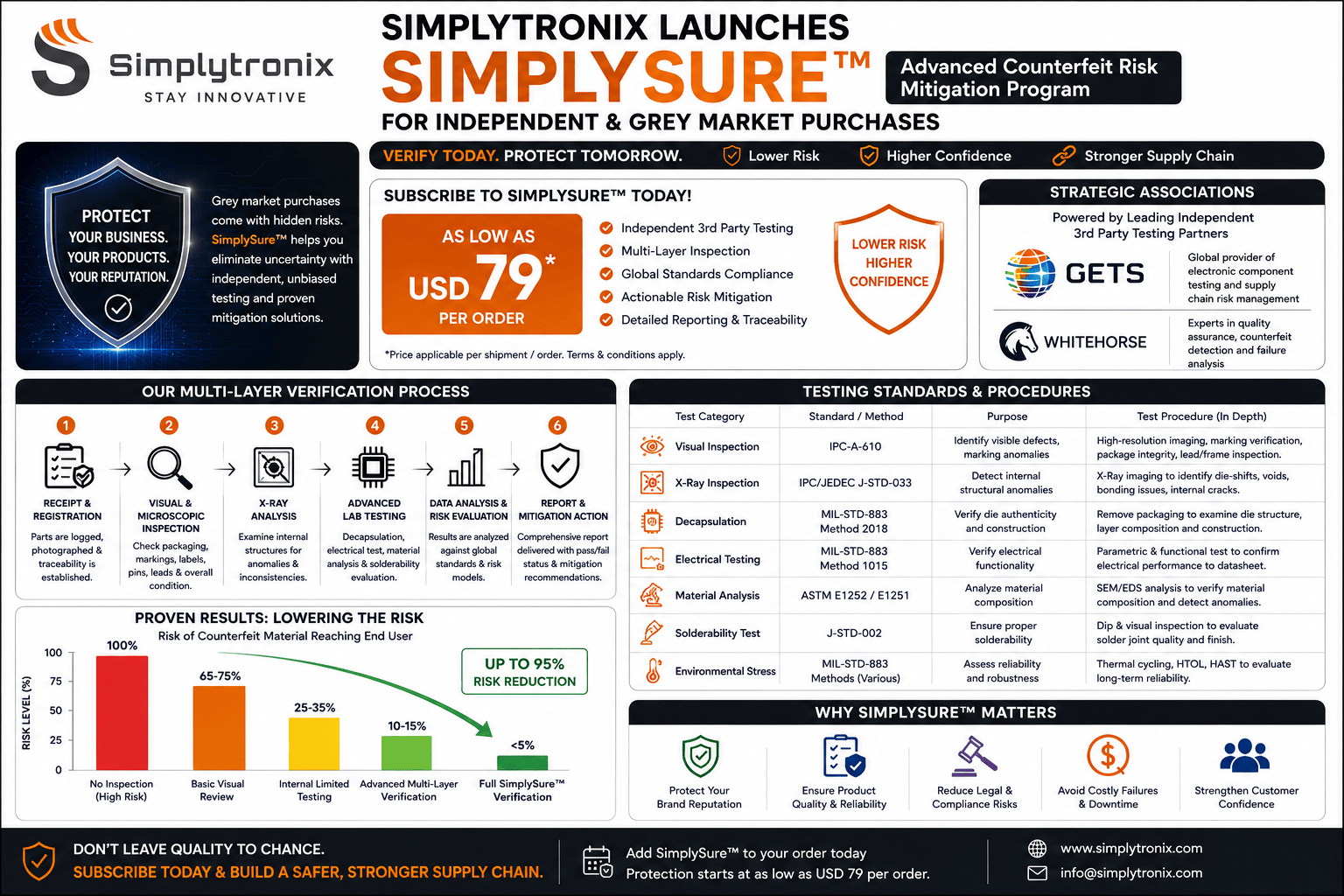
Today, Simplytronix announces SimplySure™, an advanced counterfeit risk mitigation program designed specifically for customers purchasing through independent procurement channels and secondary market ecosystems.
SimplySure™ introduces multiple verification layers, independent testing partnerships, laboratory analysis methodologies, and structured risk assessment procedures intended to dramatically reduce the probability of suspect material entering customer production environments.
Confidence Begins Before Manufacturing Starts
Protection starts at as low as USD 79 per order.
Rather than introducing expensive testing barriers or lengthy onboarding requirements, SimplySure™ can be activated directly during order placement.
This allows organizations to strengthen supply-chain confidence while maintaining operational speed.
| SimplySure™ Objectives | Expected Benefit |
|---|---|
| Counterfeit risk reduction | Reduced exposure to suspect inventory |
| Independent validation | Objective testing and analysis |
| Improved traceability | Enhanced procurement visibility |
| Layered verification | Multiple authentication checkpoints |
| Supply chain confidence | Improved customer assurance |
Why Modern Supply Chains Need More Than Component Availability
Historically, component sourcing often focused primarily on inventory availability and pricing. Modern supply chains, however, operate under entirely different conditions.
Organizations today increasingly evaluate sourcing partners based upon quality systems, traceability methods, testing procedures, supplier qualification frameworks, and risk management capabilities.
Counterfeit electronic components have evolved significantly over time. Earlier counterfeit products often displayed visible defects, poor labeling, and obvious inconsistencies. Modern counterfeit devices can include sophisticated remarking methods, surface refinishing techniques, reused components extracted from previously deployed systems, and modified packages designed to closely resemble authentic devices.
Because counterfeit methods continue becoming increasingly sophisticated, relying on a single verification process may not provide adequate protection.
Strategic Validation Through Independent Testing Associations
As part of the SimplySure™ framework, Simplytronix establishes strategic testing relationships with respected independent organizations for objective component analysis.
| Partner | Primary Function | Role in Verification |
|---|---|---|
| GETS | Electronic component testing | Supply-chain risk assessment and authentication |
| White Horse Laboratories | Independent laboratory services | Advanced physical and electrical verification |
Independent testing creates separation between procurement activities and validation activities, supporting objective assessment and reducing confirmation bias during material evaluation.
Behind the Shield: Understanding the SimplySure™ Multi-Layer Authentication Framework
SimplySure™ introduces a structured verification architecture designed to evaluate materials using multiple inspection techniques rather than depending on a single process.
| Inspection Layer | Purpose | Risk Addressed |
|---|---|---|
| Visual Examination | Surface inspection | Marking irregularities |
| Microscopic Analysis | Detailed package inspection | Resurfacing evidence |
| X-Ray Imaging | Internal structure analysis | Die inconsistencies |
| Decapsulation | Die authentication | False internal construction |
| Electrical Characterization | Functional validation | Performance anomalies |
| Solderability Analysis | Assembly compatibility | Reclaimed material risks |
Looking Deeper: How Each Test Procedure Works
Visual and Microscopic Analysis
Visual examination represents the first line of investigation during authentication procedures. Components undergo detailed analysis for package markings, fonts, date codes, labels, surface texture consistency, pin conditions, and mechanical integrity.
Microscopic evaluation further extends this process by revealing abnormalities that cannot easily be identified during standard inspection. Sanding marks, coating inconsistencies, package repairs, contamination residues, and unusual textures may indicate possible alteration activity.
X-Ray Structural Investigation
External appearance alone cannot guarantee authenticity. X-ray analysis allows internal examination without damaging the component package.
| Authentic Device Indicators | Potential Counterfeit Indicators |
|---|---|
| Consistent die dimensions | Unexpected die sizes |
| Uniform wire bonding | Irregular wire placement |
| Correct lead frame structure | Internal structural differences |
Decapsulation and Die Authentication
Decapsulation involves controlled removal of package material to expose the semiconductor die structure for analysis.
This procedure allows direct examination of die markings, manufacturer identifiers, fabrication characteristics, and internal architecture.
Sophisticated counterfeit methods may successfully replicate external package appearance, making internal verification increasingly valuable.
Electrical Characterization and Functional Analysis
Appearance-based inspection alone cannot determine whether a device performs according to specification requirements.
Electrical testing validates operating characteristics against expected parameters including:
- Voltage response
- Current behavior
- Timing characteristics
- Signal integrity
- Functional performance
- Thermal behavior
Risk Exposure Reduction Through Layered Testing
| Verification Stage | Relative Risk Exposure |
|---|---|
| No Inspection | 100% |
| Basic Visual Review | 65–75% |
| Internal Limited Testing | 25–35% |
| Advanced Multi-Layer Verification | 10–15% |
| Full SimplySure™ Verification | Less than 5% |
Risk Trend Visualization
Counterfeit Exposure Risk (%)

100 |■■■■■■■■■■■■■■■■■■■■■■
 70 |■■■■■■■■■■■■■■■
 50 |■■■■■■■■■
 25 |■■■■■
 05 |■

No Testing → Basic → Internal → Advanced → SimplySure™
When Availability Meets Confidence
Modern supply chains cannot rely solely on component availability. Confidence, traceability, validation, and intelligent risk mitigation increasingly determine procurement success.
SimplySure™ was developed around a simple principle:
Source Smarter. Verify Deeper. Build with Confidence.