Counterfeit Components: A Growing Global Problem
The global electronics supply chain has become increasingly complex over the past decade. Component shortages, extended lead times, geopolitical disruptions, and the rapid growth of online marketplaces have all created opportunities for counterfeit parts to enter legitimate procurement channels.
According to industry studies, counterfeit semiconductors and electronic components cost manufacturers billions of dollars annually through production delays, warranty claims, product recalls, and system failures. The problem is particularly severe for organizations sourcing obsolete or end-of-life (EOL) components where authorized inventory may no longer be available.
| Industry Sector | Counterfeit Risk Level | Potential Impact |
|---|---|---|
| Aerospace & Defense | Very High | Mission failure, safety hazards |
| Medical Devices | Very High | Patient safety risks |
| Automotive | High | Vehicle malfunction |
| Industrial Automation | High | Production downtime |
| Consumer Electronics | Medium | Warranty and reliability issues |
Why Counterfeit Components Are Difficult to Detect
Modern counterfeiters have become increasingly sophisticated. Many fraudulent parts are visually indistinguishable from genuine devices. Counterfeit operations often use advanced resurfacing techniques, laser remarking equipment, and forged documentation that can initially pass basic inspection.
As a result, organizations must rely on structured inspection procedures such as those defined by AS6081 rather than visual assessment alone.
Common Types of Counterfeit Components
| Counterfeit Type | Description | Detection Method |
|---|---|---|
| Remarked Parts | Original markings removed and replaced | Microscopic inspection |
| Recycled Components | Recovered from scrap electronics | X-Ray and lead analysis |
| Cloned Devices | Unauthorized copies of genuine parts | Electrical testing |
| Forged Documentation | Fake certificates and traceability records | Document verification |
| Substituted Components | Lower-grade parts sold as premium devices | Functional testing |
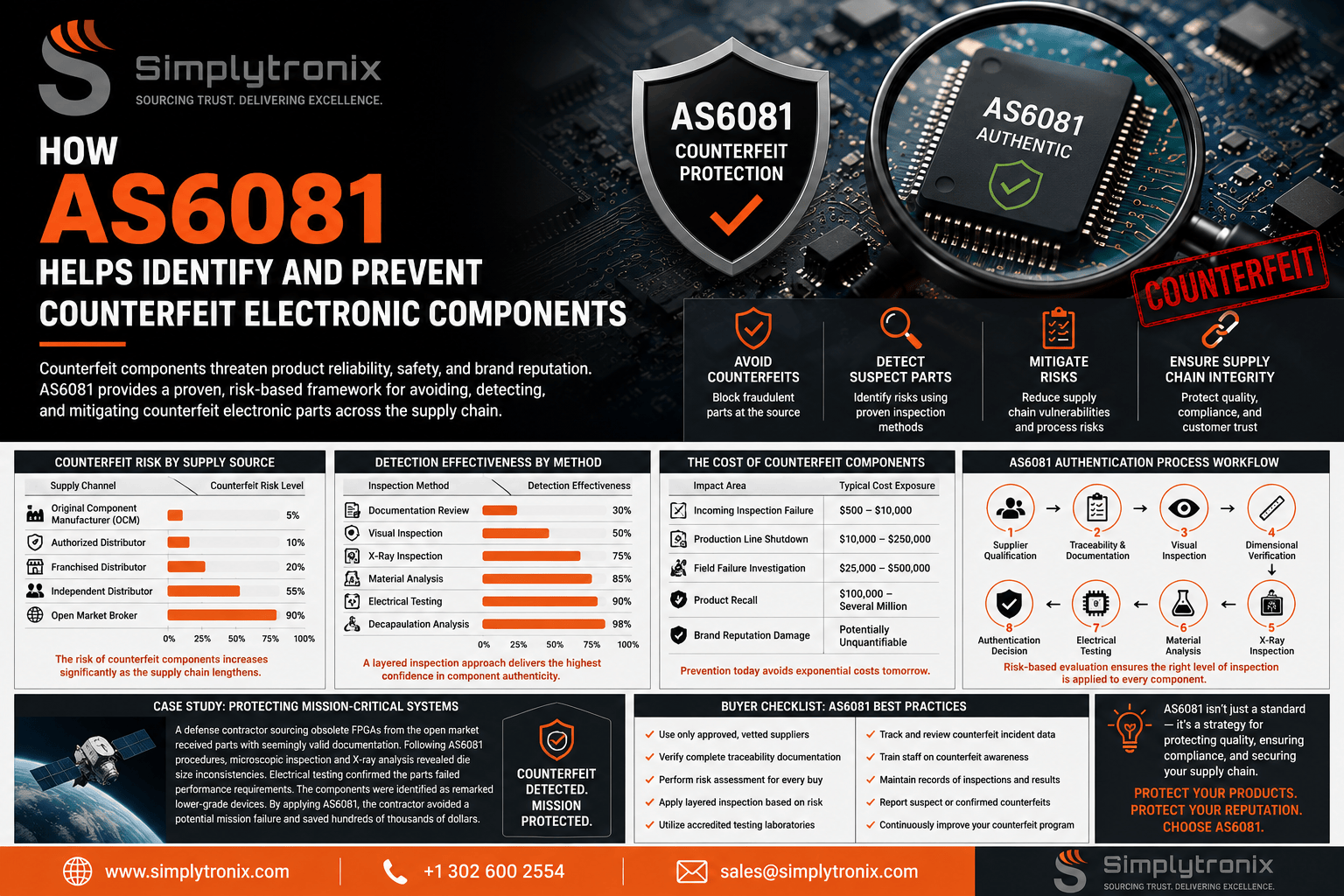
AS6081 Counterfeit Detection Workflow
Supplier Qualification
          ↓
Documentation Review
          ↓
Visual Inspection
          ↓
Dimensional Verification
          ↓
X-Ray Analysis
          ↓
Material Testing
          ↓
Electrical Testing
          ↓
Authenticity Decision
This structured workflow ensures that suspect components are progressively evaluated using increasingly advanced inspection methods.
Risk-Based Inspection Strategy Under AS6081
One of AS6081's most valuable contributions is its risk-based inspection methodology.
| Risk Level | Source Type | Required Inspection Intensity |
|---|---|---|
| Low | Authorized Distributor | Basic Verification |
| Medium | Franchised Independent Supplier | Enhanced Inspection |
| High | Open Market Supplier | Advanced Testing |
| Very High | Unknown Source | Full Authentication Program |
Visual Representation of Inspection Coverage
Inspection Coverage by Method
| Method | Approximate Detection Capability |
|---|---|
| Documentation Review | 25% |
| Visual Inspection | 45% |
| X-Ray Analysis | 70% |
| Electrical Testing | 85% |
| Decapsulation Analysis | 95%+ |
The Financial Impact of Counterfeit Components
The direct cost of purchasing counterfeit components is often only a small fraction of the total financial damage they cause.
| Cost Category | Potential Impact |
|---|---|
| Production Delays | $10,000 - $500,000+ |
| Product Recall | $100,000 - Millions |
| Warranty Claims | Significant recurring costs |
| Brand Reputation Damage | Long-term revenue loss |
| Regulatory Penalties | Industry-dependent |
Case Study: How AS6081 Prevented a Major Failure
A manufacturer sourcing obsolete FPGA devices from the independent market faced severe supply shortages. Although the parts arrived with apparently valid documentation, AS6081 procedures required microscopic inspection and X-Ray analysis.
The inspection revealed die dimensions inconsistent with manufacturer specifications. Further electrical testing showed that the devices failed several performance parameters.
The parts were ultimately identified as remarked lower-grade components. By following AS6081 inspection requirements, the manufacturer avoided introducing defective devices into a mission-critical aerospace application.
AS6081 vs Traditional Receiving Inspection
| Capability | Traditional Inspection | AS6081 Program |
|---|---|---|
| Supplier Qualification | Limited | Comprehensive |
| Traceability Verification | Basic | Mandatory |
| Risk Assessment | Rare | Core Requirement |
| X-Ray Inspection | Optional | Risk-Based Requirement |
| Electrical Authentication | Limited | Structured Testing |
| Counterfeit Mitigation Process | Minimal | Fully Documented |
Counterfeit Avoidance Best Practices
- Purchase from authorized sources whenever possible.
- Maintain an approved supplier program.
- Require complete traceability documentation.
- Conduct incoming inspection based on risk.
- Utilize accredited testing laboratories.
- Train procurement and quality personnel.
- Document counterfeit incidents for future prevention.
- Implement AS6081-compliant procurement procedures.
Frequently Asked Questions
Is AS6081 mandatory?
While not universally mandatory, many aerospace, defense, and government contractors require AS6081-compliant sourcing and counterfeit avoidance programs.
Does AS6081 apply only to semiconductors?
No. The standard applies broadly to electronic parts and components including integrated circuits, passive components, connectors, and electromechanical devices.
Can counterfeit parts pass electrical testing?
Some sophisticated counterfeits may pass basic electrical tests. This is why AS6081 requires multiple layers of verification rather than relying on a single inspection method.
Why is traceability so important?
Traceability allows organizations to verify a component's journey from the original manufacturer to the end customer, significantly reducing counterfeit risk.