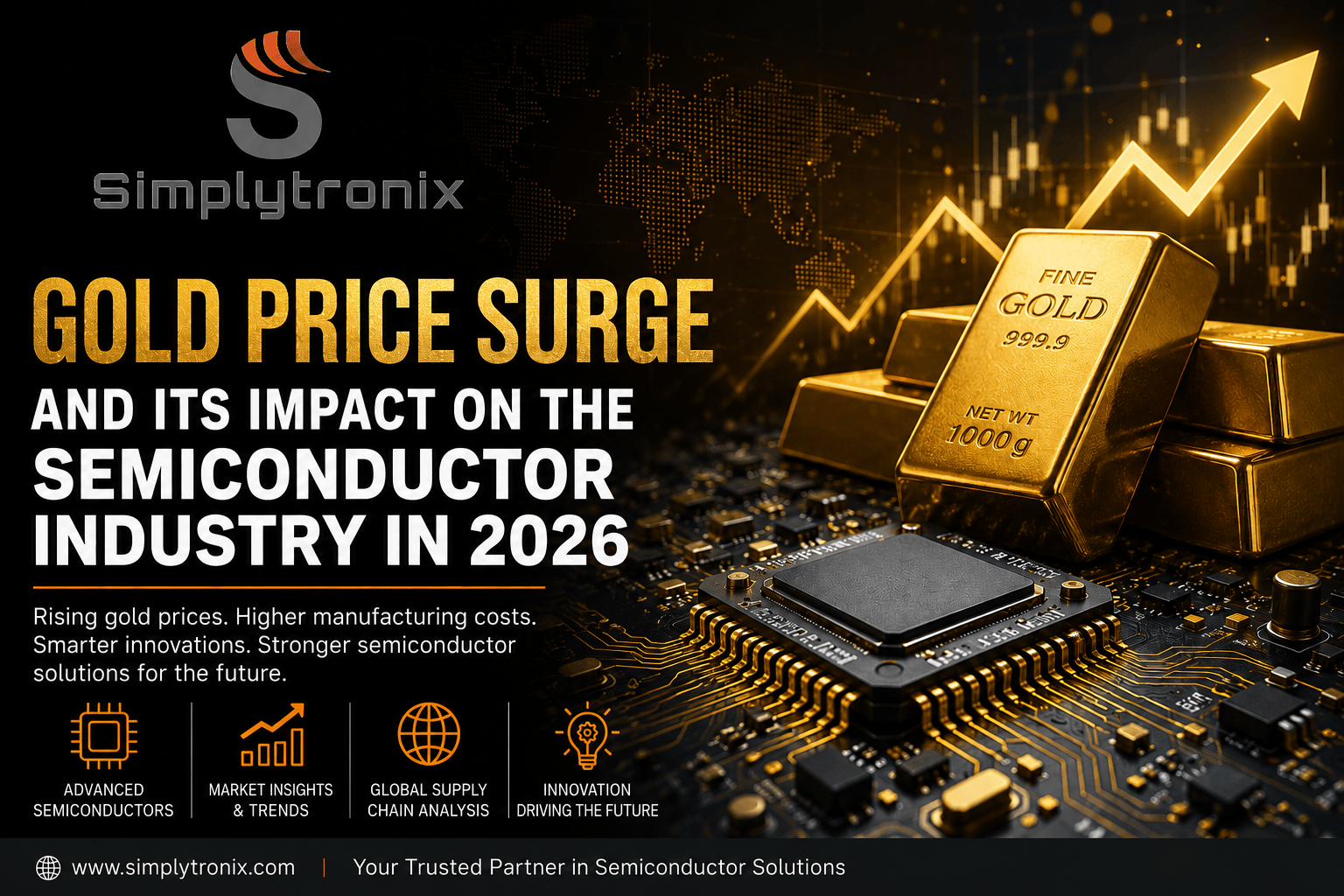
The semiconductor industry has always been deeply connected to global commodity markets, but in 2026, one particular material has become the center of industry-wide discussion: gold. Traditionally recognized as a financial safe-haven asset and a symbol of wealth preservation, gold is now playing a critical role in determining manufacturing costs, packaging strategies, and procurement decisions across the global semiconductor ecosystem.
As gold prices continue to climb due to geopolitical uncertainty, inflationary pressures, central bank accumulation, and increasing industrial demand, semiconductor manufacturers are facing new operational challenges. The rise in precious metal prices is affecting everything from integrated circuit packaging to advanced chip interconnect technologies, forcing manufacturers to evaluate alternatives, redesign supply chains, and accelerate innovation in material science.
While consumers often associate semiconductors with silicon wafers and advanced lithography machines, precious metals remain equally important in the final stages of semiconductor manufacturing. Gold plays a vital role in wire bonding, high-frequency RF applications, advanced integrated circuits, aerospace-grade electronics, military systems, telecommunications infrastructure, medical devices, and electric vehicle electronics.
The impact of rising gold prices is therefore not isolated to commodity traders or investors. It directly influences chip manufacturing economics, product pricing, supply chain resilience, and long-term technology development. Companies operating in AI infrastructure, cloud computing, industrial automation, robotics, automotive electronics, defense electronics, and consumer devices are all indirectly exposed to fluctuations in gold pricing.
This article provides a comprehensive analysis of how the global gold price surge is reshaping the semiconductor industry in 2026, including manufacturing challenges, technological adaptations, supply chain implications, investment trends, material engineering innovations, and future market expectations.
Understanding the Role of Gold in Semiconductor Manufacturing
Gold has been used in electronics and semiconductor manufacturing for decades because of its exceptional physical and electrical properties. Unlike many other conductive materials, gold resists oxidation, maintains long-term reliability, and offers excellent conductivity under demanding environmental conditions.
In semiconductor manufacturing, gold is commonly used in:
- Wire bonding for chip packaging
- High-frequency RF semiconductor devices
- Advanced connectors and contacts
- Aerospace-grade electronics
- Medical semiconductor devices
- Military and defense integrated systems
- Photonic and optoelectronic devices
- MEMS sensors
- Satellite communication systems
- Automotive safety electronics
One of the most critical applications is gold bonding wire technology. During semiconductor packaging, ultra-thin gold wires connect the silicon die to the package leads or substrate. These microscopic connections are essential for reliable electrical communication between the chip and the external circuit.
Despite efforts to reduce gold dependency, many high-reliability applications still depend heavily on gold due to its unmatched corrosion resistance and conductivity stability. Even small fluctuations in gold prices can therefore produce significant cost implications when scaled across billions of semiconductor units.
Global Gold Price Trends in 2026
Gold prices reached historic highs in 2026 as multiple economic and geopolitical factors converged simultaneously. The precious metal market experienced sustained momentum throughout the year, driven by institutional investment, global financial instability, and increasing industrial demand.
| Factor | Impact on Gold Prices |
|---|---|
| Inflation Concerns | Increased investor demand for safe-haven assets |
| Geopolitical Tensions | Higher global uncertainty increased gold accumulation |
| Central Bank Purchases | Reduced market supply availability |
| Industrial Demand | Growing semiconductor and EV sector consumption |
| Mining Constraints | Limited production growth and higher extraction costs |
| Currency Volatility | Strengthened gold investment demand |
The semiconductor industry is particularly vulnerable because gold usage cannot always be reduced without compromising reliability or performance. High-end semiconductor packaging still requires precious metal integration, especially in mission-critical systems.
The Semiconductor Industry’s Dependence on Precious Metals
Although silicon forms the foundation of semiconductor technology, modern electronics rely on a complex ecosystem of specialty materials and precious metals. Gold, silver, palladium, platinum, copper, cobalt, and rare earth elements all contribute to semiconductor manufacturing processes.
Gold remains particularly valuable because of its:
- Superior conductivity
- Resistance to corrosion
- Long-term stability
- High-temperature performance
- Excellent bonding characteristics
- Minimal signal degradation
Industries with strict reliability requirements continue using gold despite rising prices because system failures can be significantly more expensive than material costs.
For example:
| Industry | Why Gold Is Important |
|---|---|
| Aerospace | Extreme reliability and corrosion resistance |
| Medical Devices | Long operational lifespan and precision conductivity |
| Defense Systems | Harsh environment durability |
| Automotive Electronics | Safety-critical component stability |
| Telecommunications | High-frequency signal integrity |
| AI Infrastructure | High-performance interconnect reliability |
How Rising Gold Prices Affect Semiconductor Manufacturing Costs
Semiconductor manufacturing is already one of the most capital-intensive industries in the world. Advanced fabrication facilities cost billions of dollars to build and maintain. Rising raw material costs add additional pressure to already complex production economics.
Gold price increases affect manufacturers in several key areas:
1. Wire Bonding Costs
Wire bonding remains one of the most common semiconductor packaging methods globally. Even though copper wire adoption has increased, gold wire bonding continues to dominate in premium and high-reliability applications.
When gold prices rise:
- Packaging costs increase
- Assembly margins shrink
- Contract manufacturers face pricing pressure
- Procurement budgets expand
- Inventory management becomes more volatile
2. High-End Semiconductor Packaging
Advanced chip packaging technologies often use gold-coated interconnects and substrates for performance optimization. AI accelerators, server processors, networking chips, and HPC systems increasingly depend on sophisticated packaging architectures.
These premium semiconductor products consume higher-value materials and therefore become more exposed to precious metal volatility.
3. Testing and Reliability Certification
Manufacturers may need to perform additional testing when switching to lower-cost alternatives such as copper or silver alloys. This introduces:
- Higher validation costs
- Extended development cycles
- Increased engineering complexity
- Reliability verification expenses
The Shift from Gold to Copper Bonding Wires
One of the largest trends accelerated by rising gold prices is the migration toward copper bonding wire technology.
Copper offers significant cost advantages compared to gold:
| Property | Gold | Copper |
|---|---|---|
| Cost | Very High | Lower |
| Conductivity | Excellent | Excellent |
| Oxidation Resistance | Superior | Lower |
| Mechanical Strength | High | Very High |
| Reliability | Excellent | Application Dependent |
However, copper introduces several engineering challenges:
- Oxidation susceptibility
- More complex bonding environments
- Higher process sensitivity
- Long-term corrosion risks
- Potential reliability concerns in harsh environments
As a result, many manufacturers continue using gold for premium applications despite higher costs.
AI Boom Is Increasing Semiconductor Material Demand
Artificial Intelligence has become one of the largest drivers of semiconductor demand in modern history. AI servers, training clusters, edge AI devices, robotics platforms, and data centers require massive amounts of high-performance semiconductor hardware.
AI accelerator chips consume advanced packaging technologies that often rely on premium conductive materials and high-density interconnect solutions.
The AI boom therefore indirectly increases demand for:
- Gold interconnect materials
- Advanced substrates
- High-frequency connectors
- Thermal management systems
- Precision semiconductor packaging
As AI infrastructure expands globally, semiconductor manufacturers are balancing explosive growth opportunities with increasing material costs.
Impact on Automotive Electronics
The automotive industry has become one of the largest semiconductor consumers worldwide. Modern vehicles now contain thousands of semiconductor components controlling:
- ADAS systems
- Battery management
- Electric drivetrains
- Infotainment systems
- Autonomous driving sensors
- Safety systems
- Power electronics
Automotive electronics require high reliability because component failures can directly affect passenger safety.
Gold remains important in:
- Automotive sensors
- Radar systems
- Power modules
- Microcontrollers
- Advanced driver assistance systems
As electric vehicle production accelerates globally, semiconductor material demand continues increasing simultaneously with rising precious metal prices.
Semiconductor Supply Chain Challenges
The semiconductor industry operates through one of the most globally interconnected supply chains in existence. Gold price volatility introduces new supply chain management challenges:
| Challenge | Industry Impact |
|---|---|
| Price Volatility | Unpredictable production costs |
| Material Availability | Procurement complexity |
| Supplier Dependence | Concentration risks |
| Inventory Management | Higher carrying costs |
| Geopolitical Risks | Trade disruptions |
| Transportation Costs | Higher logistics expenses |
Manufacturers are therefore investing heavily in:
- Supply chain diversification
- Material recycling
- Strategic procurement agreements
- Regional manufacturing expansion
- Inventory optimization systems
Advanced Packaging Technologies Reducing Gold Dependency
The semiconductor industry is actively developing advanced packaging technologies that reduce dependency on expensive materials while improving performance.
Chiplet Architectures
Chiplet-based semiconductor designs divide large processors into smaller interconnected components. This approach:
- Improves manufacturing efficiency
- Reduces material waste
- Optimizes packaging flexibility
- Enhances scalability
3D Packaging
3D semiconductor stacking technologies increase density and performance while reducing overall package footprint.
Wafer-Level Packaging
Wafer-level packaging enables higher integration efficiency and material optimization compared to traditional packaging methods.
Impact on Consumer Electronics
Rising semiconductor manufacturing costs eventually influence consumer electronics pricing. Smartphones, laptops, gaming systems, wearables, smart home devices, networking equipment, and industrial IoT systems all rely heavily on semiconductor supply chains.
Potential market impacts include:
- Higher electronics prices
- Longer product refresh cycles
- Reduced manufacturer margins
- Greater emphasis on premium products
- Cost optimization in component design
Manufacturers are increasingly seeking ways to maintain profitability without significantly increasing retail pricing.
Gold Recycling in Semiconductor Manufacturing
Recycling is becoming increasingly important as gold prices rise.
Semiconductor manufacturers and electronics recyclers are expanding precious metal recovery operations from:
- Discarded electronics
- Industrial scrap
- Production waste
- Data center hardware
- Telecommunications equipment
- Consumer electronics
Gold recycling helps:
- Reduce raw material dependency
- Lower environmental impact
- Improve supply chain sustainability
- Control procurement costs
Geopolitical Influence on Semiconductor Materials
Global semiconductor supply chains are increasingly influenced by geopolitical developments. Trade restrictions, export controls, sanctions, and regional manufacturing policies all affect access to semiconductor materials and precious metals.
Governments worldwide are investing heavily in domestic semiconductor manufacturing capabilities to reduce external dependencies.
| Region | Primary Focus |
|---|---|
| United States | Domestic fabrication expansion |
| Europe | Supply chain resilience |
| China | Semiconductor self-sufficiency |
| Japan | Advanced materials leadership |
| South Korea | Memory and packaging dominance |
| India | Semiconductor ecosystem development |
The Future of Semiconductor Materials Engineering
The rising cost of gold is accelerating innovation in semiconductor materials engineering. Research institutions and manufacturers are exploring:
- Alternative conductive materials
- Nano-scale interconnect technologies
- Graphene-based conductors
- Advanced copper alloys
- Silver sintering technologies
- Carbon nanotube interconnections
Although many of these technologies remain under development, rising commodity prices are accelerating commercialization efforts.
Long-Term Industry Outlook
Despite rising material costs, the semiconductor industry is expected to continue experiencing strong long-term growth due to increasing digitalization worldwide.
Major growth drivers include:
- Artificial Intelligence
- Electric Vehicles
- Industrial Automation
- Cloud Computing
- 5G Infrastructure
- Smart Manufacturing
- Internet of Things
- Robotics
- Defense Electronics
- Medical Technology
Semiconductor demand growth will likely continue outpacing many other industrial sectors over the next decade.
Strategic Responses from Semiconductor Companies
Leading semiconductor companies are implementing multiple strategies to manage rising gold costs:
| Strategy | Purpose |
|---|---|
| Material Optimization | Reduce precious metal usage |
| Supplier Diversification | Lower procurement risk |
| Recycling Programs | Recover valuable materials |
| Advanced Packaging | Improve efficiency |
| Automation | Offset manufacturing costs |
| Long-Term Contracts | Stabilize pricing |
Conclusion
The 2026 gold price surge represents far more than a commodity market trend. It has become a defining factor influencing semiconductor manufacturing economics, packaging technologies, supply chain strategies, and global electronics innovation.
Gold remains a critical material for high-reliability semiconductor applications, but rising prices are forcing the industry to evolve rapidly. Manufacturers are accelerating research into alternative materials, advanced packaging architectures, recycling technologies, and supply chain resilience initiatives.
At the same time, demand for semiconductors continues growing due to Artificial Intelligence, electric vehicles, industrial automation, telecommunications infrastructure, and global digital transformation. This creates a unique challenge where rising material costs coincide with unprecedented market demand.
The semiconductor companies that successfully adapt through engineering innovation, strategic sourcing, material optimization, and advanced manufacturing technologies will be best positioned to lead the next generation of global electronics development.
As the semiconductor industry enters a new era of AI-driven expansion and supply chain transformation, gold pricing will remain one of the most closely watched variables shaping the future of electronics manufacturing worldwide.