How IGBT Works: Complete Guide to the Working Principle, Structure, Applications and Role in Modern Power Electronics
Power electronics has become one of the most important technologies driving the modern world. Whether we look at electric vehicles moving silently on roads, industrial automation systems operating with precision, renewable energy systems converting sunlight into usable electricity, or high-speed railway networks transporting millions of people, all of these systems depend heavily on efficient power management. At the center of many of these applications lies a semiconductor device called the IGBT (Insulated Gate Bipolar Transistor).
The IGBT represents one of the most significant developments in semiconductor technology because it successfully combines the strengths of different transistor technologies into a single device. It provides the easy gate control characteristics of a MOSFET while maintaining the high-current capability of bipolar transistors. This unique combination has made IGBTs one of the preferred switching devices for medium and high-power applications across industries worldwide.
At Simplytronix, we recognize that understanding semiconductor technologies is increasingly important for manufacturers, engineers, procurement teams, and supply chain professionals. Semiconductor devices are no longer just components soldered onto circuit boards; they have become critical elements determining performance, efficiency, reliability, and even the long-term sustainability of modern systems.
This comprehensive guide explores how IGBTs work, their internal structure, operating principles, advantages, limitations, industrial applications, and their growing importance in future technologies.
Understanding the Basics of an IGBT
The term IGBT stands for Insulated Gate Bipolar Transistor. As the name suggests, the device combines an insulated gate structure with bipolar conduction characteristics. It functions primarily as an electronic switch capable of controlling large amounts of electrical power using a relatively small control signal.
Before IGBTs were developed, engineers commonly relied on BJTs and MOSFETs independently for switching applications. Each technology offered advantages but also presented significant limitations.
| Technology | Main Strength | Main Limitation |
|---|---|---|
| BJT | High current handling capability | Requires high drive current |
| MOSFET | Fast switching and easy control | Higher losses at high voltage |
| IGBT | Combines both advantages | Slightly slower than MOSFETs |
The development of IGBTs provided a practical solution that could handle high voltages and large currents while requiring relatively low input power for operation.
Internal Structure of an IGBT
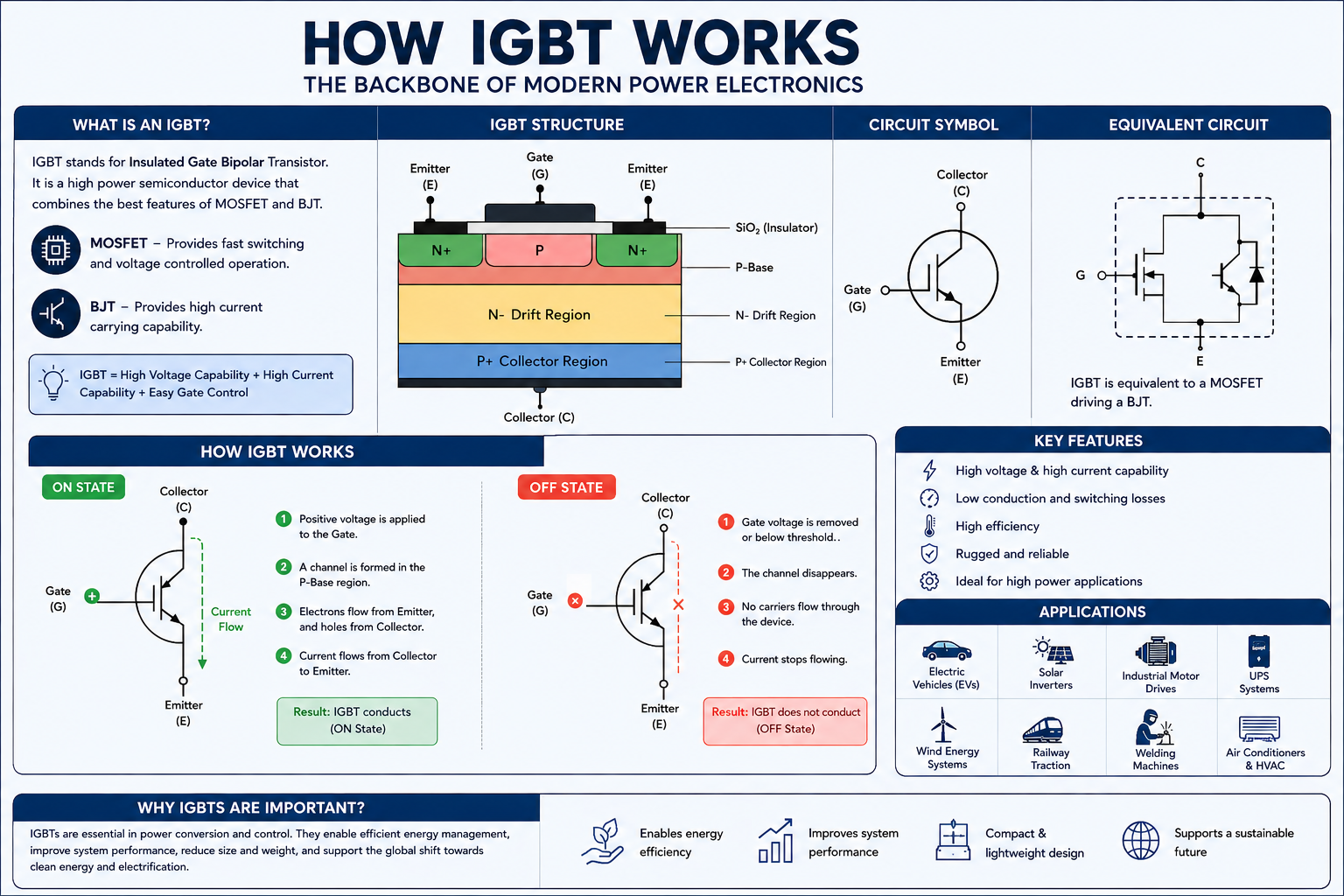
To understand how an IGBT works, it is important to understand its internal construction. The device consists of several semiconductor layers arranged carefully to achieve efficient switching behavior.
| Layer | Function |
|---|---|
| P+ Collector Layer | Injects charge carriers |
| N- Drift Region | Supports voltage blocking |
| P Base Region | Controls carrier movement |
| N+ Emitter Region | Provides electron flow |
| Gate Oxide Layer | Insulates control gate |
The gate itself remains electrically insulated from the current path, which significantly reduces the control power requirements. This insulated structure is one of the major reasons why IGBTs have become so popular in industrial electronics.
How an IGBT Actually Works
The operating principle of an IGBT can initially appear complex, but understanding it becomes easier when viewed as a sequence of events.
Initially, when no voltage is applied at the gate terminal, the device remains in the OFF state. Under this condition, current cannot flow between the collector and emitter terminals because the conduction path does not exist.
When a positive voltage is applied to the gate terminal, an electric field develops beneath the gate oxide layer. This electric field creates a conductive channel inside the semiconductor structure. The channel allows electrons to move through the device and initiate carrier injection into the drift region.
Once this process starts, current begins flowing from collector to emitter. Since the current path becomes established, the IGBT enters its ON state and conducts large amounts of electrical power efficiently.
When gate voltage is removed, the conductive channel disappears, interrupting carrier flow and switching the device back to its OFF state.
Switching Process in Detail
| Step | Process | Result |
|---|---|---|
| 1 | Gate voltage applied | Electric field generated |
| 2 | Channel formation | Electron movement begins |
| 3 | Carrier injection occurs | Current flow starts |
| 4 | Device fully ON | Power transfer takes place |
| 5 | Gate signal removed | Current stops |
Advantages of IGBTs
Several characteristics have made IGBTs highly attractive for industrial use. One major advantage is their high efficiency in medium and high-power systems. Lower conduction losses result in reduced heat generation, improving system reliability and lowering cooling requirements.
Another important advantage is the ease of control. Because the gate is insulated, the control circuitry consumes relatively little power compared to older transistor technologies.
| Advantage | Impact |
|---|---|
| High voltage capability | Suitable for industrial systems |
| Low gate power requirement | Simplified driver design |
| Lower switching losses | Improved efficiency |
| High current capability | Supports demanding applications |
| Better thermal performance | Longer operational life |
Limitations of IGBTs
Although IGBTs provide numerous benefits, they also have limitations. Compared to MOSFETs, IGBTs generally switch more slowly because of stored charge carriers inside the device structure.
This makes MOSFETs more suitable for very high-frequency applications such as low-power switching power supplies, while IGBTs remain preferable for medium and high-power applications.
Industrial Applications of IGBTs
IGBTs have become a critical technology in modern industries because of their ability to efficiently control large amounts of electrical power.
| Industry | Application |
|---|---|
| Automotive | Electric vehicle motor control |
| Renewable Energy | Solar inverters |
| Manufacturing | Industrial motor drives |
| Transportation | Railway traction systems |
| Power Electronics | UPS and inverter systems |
| Medical Equipment | High-power imaging systems |
IGBTs in Electric Vehicles
The growth of electric vehicles has dramatically increased demand for power semiconductors. In electric vehicles, IGBTs convert battery DC power into AC power used by electric motors. These devices operate continuously while maintaining high efficiency levels and minimizing energy losses.
Without efficient power conversion systems based on semiconductor technologies such as IGBTs, electric vehicles would experience shorter battery life, lower driving range, and increased heat generation.
Thermal Management Considerations
Heat management is one of the most critical factors affecting IGBT reliability. During operation, switching losses and conduction losses generate heat inside the device.
Engineers often implement thermal management techniques including heat sinks, cooling fans, liquid cooling systems, and thermal interface materials to maintain safe operating temperatures.
| Cooling Method | Typical Application |
|---|---|
| Passive Heat Sink | Small systems |
| Forced Air Cooling | Industrial drives |
| Liquid Cooling | Electric vehicles |
| Advanced Thermal Systems | High-power equipment |
Future of IGBT Technology
Semiconductor technology continues evolving rapidly. Modern research focuses on improving switching speed, reducing losses, increasing thermal performance, and enhancing reliability.
New materials such as silicon carbide and gallium nitride are creating additional opportunities in power electronics, but traditional IGBT technology continues to remain highly relevant because of its cost effectiveness and proven reliability across industrial applications.
As industries increasingly move toward electrification, renewable energy adoption, and automation, the demand for efficient power semiconductor devices is expected to continue growing significantly.
Conclusion
IGBT technology represents one of the most important innovations in power electronics. Its ability to combine efficient switching, high current handling capability, and simple control methods makes it essential for a wide range of modern applications.
From electric vehicles and renewable energy systems to industrial automation and transportation infrastructure, IGBTs continue to power technologies that shape our future.
At Simplytronix, understanding semiconductor technologies goes beyond component sourcing. Through intelligent sourcing strategies, supplier verification methods, and supply chain transparency initiatives, we support businesses seeking reliable semiconductor solutions in an increasingly complex global market.