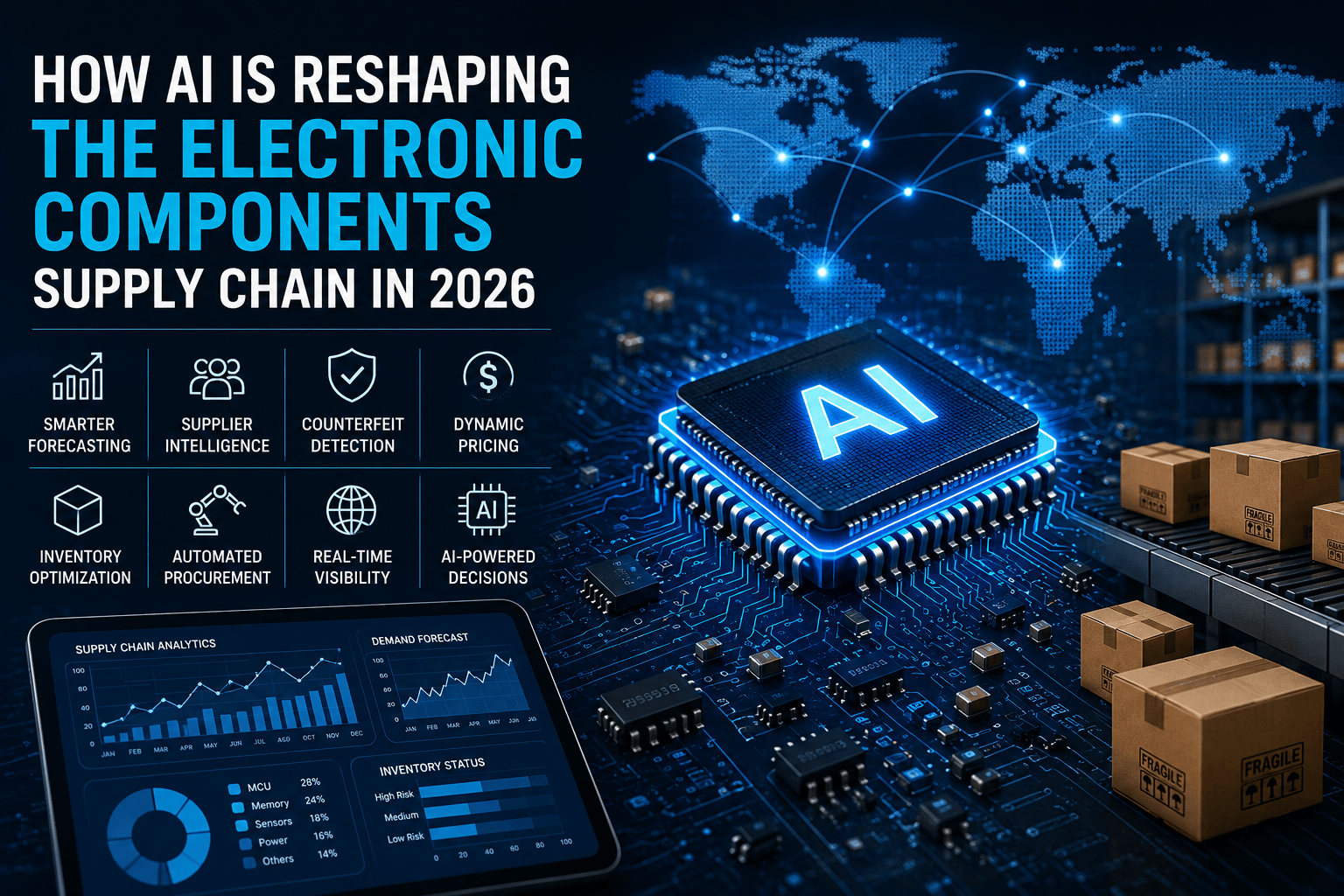
How AI Is Reshaping the Electronic Components Supply Chain in 2026
For years, the electronics industry operated on a fragile balance of forecasting, supplier relationships, and timing. Then came semiconductor shortages, geopolitical instability, shipping disruptions, inflated lead times, and counterfeit market growth. The traditional procurement model — dependent heavily on spreadsheets, manual RFQs, and reactive sourcing — started showing its limitations.
In 2026, the industry is entering a new operational era. Artificial Intelligence is no longer just a buzzword discussed in technology conferences; it is actively reshaping how electronic components are sourced, verified, stocked, forecasted, and distributed globally.
From OEMs and EMS companies to independent distributors and procurement teams, AI-driven systems are becoming central to modern supply chain decision-making. Companies that adapt early are reducing shortages, improving margins, and securing inventory faster than competitors.
At Simplytronix, we work closely with global buyers, suppliers, and manufacturing partners across the electronics ecosystem. What we are witnessing is clear: AI is becoming one of the most powerful competitive advantages in the electronic components market.
The Traditional Electronics Supply Chain Problem
Electronic component procurement has always been uniquely complex compared to most industries. Unlike standard commodities, semiconductors and electronic parts are highly sensitive to:
- Rapid lifecycle changes
- Factory allocation policies
- Wafer shortages
- Geopolitical disruptions
- End-of-life notices
- Counterfeit circulation
- Demand spikes from consumer markets
- Long manufacturing lead times
A single unavailable IC can delay an entire production line worth millions of dollars. Procurement teams often spend hours manually comparing supplier offers, validating stock availability, analyzing date codes, and negotiating pricing.
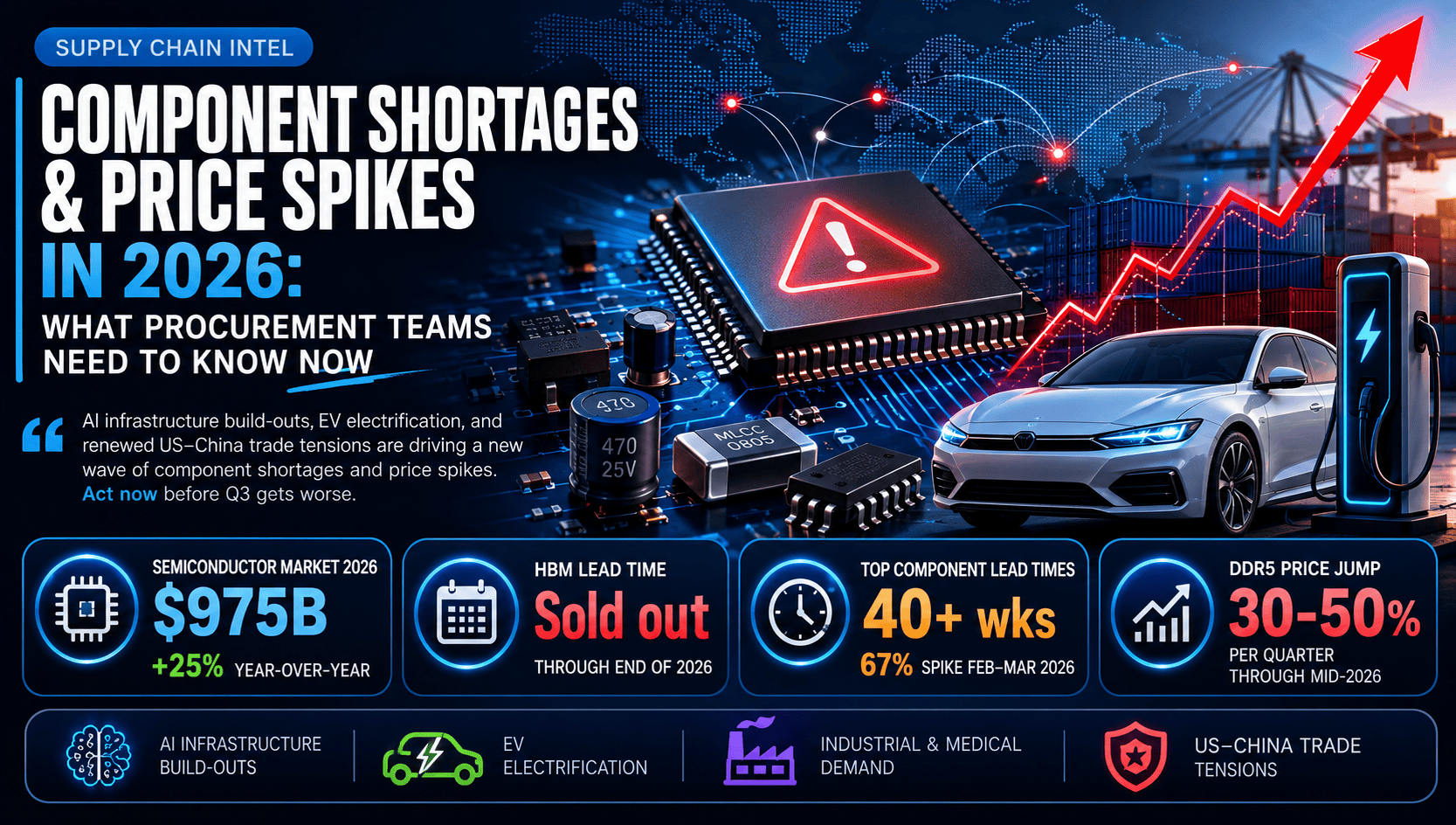
The problem becomes even more severe during market shortages. Lead times can suddenly jump from 8 weeks to 52 weeks. Pricing volatility becomes extreme. Authorized channels dry up quickly, pushing buyers into risky grey-market sourcing.
This is exactly where AI is changing the game.
Where AI Is Creating the Biggest Impact
1. Intelligent Demand Forecasting
One of the biggest failures in traditional procurement systems is inaccurate forecasting. Most ERP systems rely heavily on historical averages and static purchasing behavior. However, the electronics industry changes far too rapidly for static models to remain effective.
AI-driven forecasting engines can now analyze:
- Historical consumption patterns
- Global shortage indicators
- OEM production trends
- Commodity pricing
- Supplier shipment behavior
- Regional manufacturing growth
- News and geopolitical events
Instead of merely reacting to shortages, procurement teams can proactively secure inventory before supply disruptions happen.
| Traditional Forecasting | AI-Based Forecasting |
|---|---|
| Historical average driven | Real-time adaptive models |
| Manual spreadsheet analysis | Automated predictive analytics |
| Reactive purchasing | Proactive inventory planning |
| Limited market visibility | Global trend monitoring |
For high-risk categories such as eMMC, DDR memory, power management ICs, and automotive semiconductors, predictive sourcing is becoming essential.
2. Automated Supplier Intelligence
Modern procurement is no longer just about finding inventory. It is about finding trustworthy inventory.
AI systems are increasingly being used to evaluate supplier reliability using:
- Historical fulfillment rates
- Response consistency
- Quality incident history
- Pricing anomalies
- Shipping performance
- Risk scoring
- Market reputation analysis
Instead of relying purely on human judgment, procurement teams now receive AI-generated supplier risk assessments before placing large orders.
This is especially important in the independent distribution market where counterfeit risk and stock misrepresentation remain major concerns.
AI can identify suspicious pricing patterns, inconsistent stock declarations, and unusual market behavior that may indicate potential sourcing risks.
3. Counterfeit Detection and Quality Assurance
Counterfeit components continue to be one of the industry's most dangerous problems. Fake or refurbished ICs can lead to catastrophic failures in medical, automotive, industrial, and aerospace applications.
AI-powered visual inspection systems are now assisting in counterfeit detection through:
- Laser marking analysis
- Surface texture recognition
- Date code verification
- Package consistency checks
- X-ray comparison models
- Optical anomaly detection
Machine learning systems can analyze thousands of authentic component images and compare them against incoming inventory to identify inconsistencies invisible to the human eye.
This technology is becoming increasingly valuable for brokers, testing laboratories, and procurement companies managing spot-buy transactions.
4. AI-Powered Dynamic Pricing
Electronic component pricing is extremely volatile. A part priced at $3 today may jump to $28 within weeks during allocation periods.
Traditional pricing methods struggle to react fast enough. AI-driven pricing systems now monitor:
- Live market demand
- Available global inventory
- Factory allocation trends
- Lead-time movements
- Historical shortage cycles
- Broker market activity
This allows distributors and sourcing companies to:
- Adjust quotations faster
- Protect margins
- Avoid overpaying during panic buying
- Identify future pricing spikes early
In highly volatile categories such as NAND Flash, UFS storage, GPUs, and automotive MCUs, dynamic pricing intelligence is becoming a critical operational tool.
5. Smarter Inventory Management
Overstock and dead inventory have always been major financial problems in electronics distribution. At the same time, understocking creates missed sales opportunities and production delays.
AI inventory systems help companies optimize stock positioning by analyzing:
- Consumption velocity
- Regional demand shifts
- Seasonal purchasing cycles
- Customer reorder behavior
- Lead-time risks
- Alternative component availability
This creates more efficient warehousing strategies while improving cash flow management.
| Inventory Challenge | AI Solution |
|---|---|
| Dead stock accumulation | Demand prediction analysis |
| Unexpected shortages | Early risk alerts |
| Manual stock planning | Automated replenishment models |
| Slow-moving inventory | Intelligent redistribution insights |
The Rise of AI-Enhanced Procurement Platforms
Modern sourcing platforms are evolving rapidly. Instead of acting as static RFQ portals, next-generation procurement systems are becoming intelligent sourcing ecosystems.
Advanced AI procurement platforms can now:
- Match buyers with verified suppliers automatically
- Recommend alternate parts
- Predict lead-time risks
- Detect unrealistic quotations
- Analyze BOM exposure
- Automate supplier communication
- Track market shortages in real time
This reduces procurement cycle time dramatically while improving sourcing accuracy.
Companies that previously needed several sourcing specialists can now scale operations far more efficiently with AI-assisted workflows.
Will AI Replace Human Procurement Teams?
This is one of the most common questions across the industry. The answer is no — but procurement roles are changing significantly.
AI is excellent at:
- Analyzing massive datasets
- Detecting patterns
- Generating forecasts
- Monitoring risks
- Automating repetitive processes
However, electronic component sourcing still depends heavily on:
- Relationship management
- Negotiation skills
- Supplier trust
- Technical evaluation
- Strategic decision-making
The future is not AI replacing procurement professionals. The future is AI augmenting procurement professionals.
The companies achieving the best results are combining experienced sourcing teams with intelligent AI infrastructure.
Challenges of AI Adoption in Electronics Distribution
Despite the advantages, AI implementation is not without challenges.
Some of the biggest barriers include:
- Fragmented supplier data
- Inconsistent inventory reporting
- Lack of standardization
- ERP integration complexity
- High-quality training data requirements
- Cybersecurity concerns
Many distributors still operate with legacy systems that were never designed for AI integration. Transitioning to modern intelligent infrastructure requires both investment and operational change.
However, as supply chain complexity continues increasing, delaying modernization may become far more expensive than adopting it.
The Future of Electronics Supply Chains
Over the next five years, AI adoption across the electronics industry is expected to accelerate dramatically.
We are likely to see:
- Fully automated RFQ processing
- AI-generated sourcing recommendations
- Predictive shortage alerts
- Real-time global inventory mapping
- Autonomous procurement systems
- Advanced counterfeit prevention networks
- AI-driven supplier negotiation assistance
The electronics supply chain is becoming increasingly data-driven. Companies that leverage AI effectively will gain major advantages in:
- Speed
- Pricing accuracy
- Inventory control
- Risk reduction
- Customer responsiveness
Final Thoughts
The global electronic components market is evolving faster than ever before. Traditional sourcing models alone are no longer sufficient for navigating modern supply chain volatility.
Artificial Intelligence is transforming how companies forecast demand, manage suppliers, optimize inventory, detect counterfeits, and secure components in increasingly competitive markets.
For distributors, OEMs, EMS providers, and procurement teams, AI is quickly shifting from an optional innovation to a strategic necessity.
At Simplytronix, we continue monitoring emerging technologies and global supply chain trends closely to help our customers source electronic components more efficiently, securely, and competitively.
The future of electronics procurement will not be driven solely by inventory. It will be driven by intelligence.